
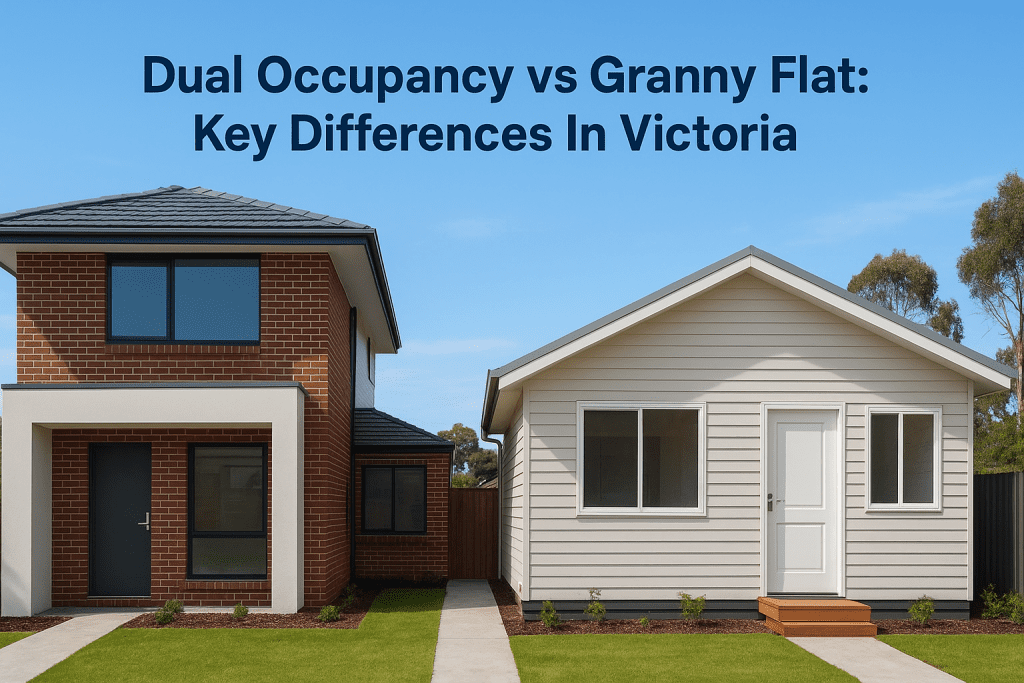
Dual Occupancy vs Granny Flat: Key Differences In Victoria
If you own a block of land in Melbourne and want to make more of it, you’ve probably weighed up dual occupancy vs granny flat at some point. Both options let you add a second dwelling to your property, but they sit in very different categories under Victorian planning rules, and that distinction affects everything from what you can build to what it’s worth down the track. A granny flat (or dependant person’s unit) comes with specific restrictions on size, occupancy, and resale. A dual occupancy, on the other hand, creates two fully independent homes that can each be separately titled and sold. The right choice depends on your goals, your site, and how much flexibility you need. Getting this wrong can mean wasted time, money, and planning applications that lead nowhere. At Transformer Homes, we design and build dual occupancy developments across Melbourne’s northern and western suburbs. We’ve helped property owners in areas like Northcote, Preston, and Thomastown navigate exactly this decision. This guide breaks down the legal definitions, cost differences, planning requirements, and investment potential of each option so you can figure out which one actually makes sense for your property, before you commit to a path that doesn’t align with your end goal. What dual occupancy and granny flat mean in Victoria Understanding these two options starts with the legal definitions used in Victoria, because what each term means here is not what you might assume from common usage. Many people treat them as interchangeable when they are actually two fundamentally different categories under planning law, with different rules, restrictions, and outcomes attached to each. What a granny flat is under Victorian law In Victoria, a granny flat is formally known as a dependant person’s unit (DPU). The planning scheme defines it as a movable building on the same lot as an existing dwelling, intended for occupation by a person who is dependent on the main dwelling’s occupants, such as an elderly parent or adult child needing close support. The key word in that definition is "movable": the structure must be capable of being removed from the site. This classification carries significant limitations that catch many property owners off guard. The unit cannot be separately sold or titled, and it must remain genuinely connected to the main home in terms of occupancy. If the dependant occupant leaves and no replacement who fits the definition moves in, the dwelling may no longer comply with your permit conditions. Understanding this restriction before you start planning saves a lot of wasted time and money. A dependant person’s unit in Victoria cannot be subdivided or sold separately from the main dwelling, making it unsuitable if your goal is long-term investment or equity release. What a dual occupancy is under Victorian law A dual occupancy means two separate dwellings on a single lot, either positioned side by side or stacked on top of each other. Unlike a DPU, each dwelling functions as a fully independent home with its own entry, utilities, and living spaces. There is no requirement that the occupants share any family relationship or even know each other. The defining advantage of dual occupancy is the ability to subdivide the land under the Subdivision Act 1988 (Vic), which lets you create two separate titles. Once you have two titles, you can sell one dwelling independently, rent both, or live in one and use the rental income from the other to offset your mortgage. That flexibility is what makes dual occupancy the stronger choice for most property investors and owner-occupiers with a long-term financial goal. How these definitions shape your decision When you compare dual occupancy vs granny flat, the legal definitions alone tell you a great deal about which path fits your situation. A DPU is designed for a specific family circumstance, and the planning system treats it accordingly. A dual occupancy is treated as a residential development, which means more process upfront but considerably more freedom once the project is complete. Your block size, zone, and local council overlay also affect which option is even available to you. Not every property in Melbourne’s northern and western suburbs qualifies for dual occupancy development, and not every situation calls for a DPU either. The definitions are your starting point, but your specific site conditions and long-term goals are what ultimately determine which path makes sense to pursue. Why the difference matters for cost and approvals The distinction between a DPU and a dual occupancy is not just a technical label. It determines which planning pathway your project follows, how much you spend to get approval, and what the finished development is actually worth. Choosing the wrong option for your situation can add months to your timeline and tens of thousands of dollars to your costs before a single slab is poured. How the planning process differs A dependant person’s unit typically requires a straightforward permit from your local council. Because the planning scheme treats a DPU as an ancillary structure rather than a full residential development, the assessment process is generally faster and less document-heavy than what a dual occupancy requires. That said, the DPU pathway closes the door on subdivision entirely, so speed at the approval stage comes at the cost of long-term flexibility. A dual occupancy application triggers a full planning permit process, which often includes neighbour notification, council assessment against your zone’s ResCode requirements, and sometimes referral to other authorities. Dual occupancy planning permits in Victoria require your design to satisfy ResCode standards, covering setbacks, overlooking, overshadowing, and private open space. If your block sits within an overlay such as a Neighbourhood Character Overlay or a Significant Landscape Overlay, additional requirements apply and assessment times increase. This is where working with an experienced builder who understands the local planning environment saves you real money. What this means for your budget When you compare dual occupancy vs granny flat costs, the dual occupancy route involves higher upfront spending across permits, design, and construction. However, the ability to subdivide
