
Signing a building contract is one of the biggest financial commitments most people will ever make, so understanding exactly what a fixed price contract in construction means before you sign is critical. Whether you’re planning a new custom home, a renovation, or a dual occupancy project, the type of contract you agree to determines how costs are managed, who carries the financial risk, and whether you’ll face unexpected bills halfway through your build. It’s not just legal paperwork; it’s the foundation of your entire budget.
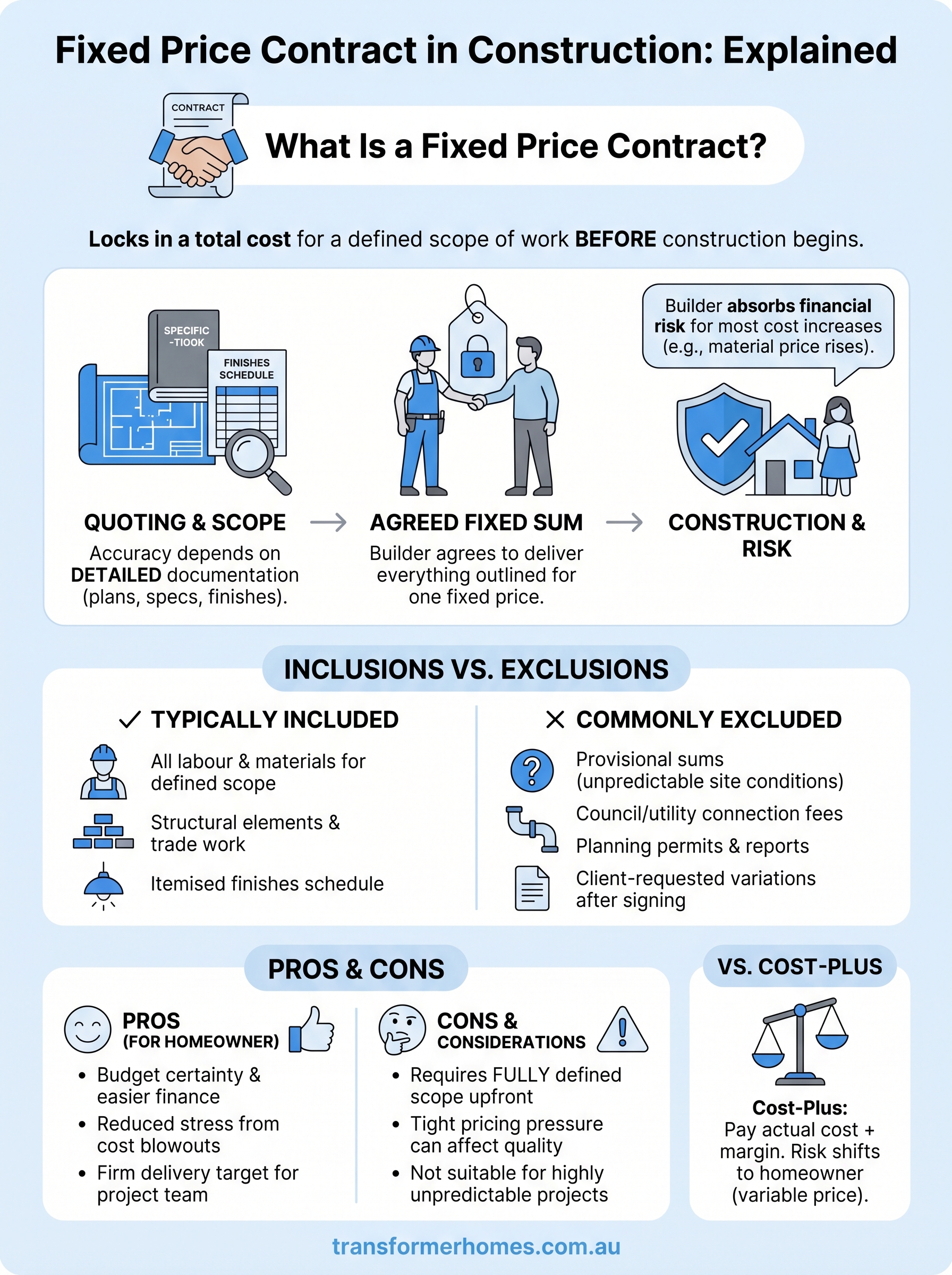
A fixed price contract locks in a total cost for a defined scope of work before construction begins. The builder agrees to deliver everything outlined in the contract for that agreed sum, regardless of whether material costs rise or the job takes longer than expected. Sounds straightforward, but there are important nuances that affect how well it protects you. There are also situations where a fixed price arrangement may not be the best fit, and understanding those trade-offs puts you in a much stronger negotiating position.
At Transformer Homes, we build custom homes and complete major renovations across Melbourne’s Northern and Western suburbs. Our clients regularly ask us about contract types, particularly how fixed price agreements compare to cost-plus or provisional sum contracts. This article breaks down how fixed price contracts actually work in residential construction, covers the real pros and cons, and explains what to watch for so you can make a confident, informed decision about your next project.
Why fixed-price contracts matter in construction
Construction projects are rarely simple, and the gap between what you expect to pay and what you actually pay can be significant if your contract doesn’t protect you. Understanding what is a fixed price contract in construction matters because it directly determines who absorbs the financial impact of cost blowouts, delays, or material price increases. When you’re spending hundreds of thousands of dollars on a new home or major renovation, that distinction is not a minor detail.
The financial risk question
In any construction project, risk sits somewhere. With a fixed price contract, the builder carries the financial risk for most cost increases once the contract is signed. If concrete prices rise or a subcontractor charges more than anticipated, that’s generally the builder’s problem to absorb, not yours. This is fundamentally different from a cost-plus arrangement, where every price movement flows directly through to your final bill.
The contract type you choose is essentially a decision about who carries financial uncertainty throughout your build.
For homeowners, certainty around budget is often the deciding factor. You can arrange finance with confidence, plan your move-in timeline, and avoid the stress of watching costs climb week by week. For builders, fixed price contracts require accurate upfront estimating, because underquoting the scope means absorbing losses on the job.
Why builders price the way they do
Builders factor in a contingency margin when pricing a fixed price contract. This covers foreseeable risks like minor price fluctuations, weather delays, and variations in labour time. It is not padding for profit; it is responsible estimating that protects both parties. When a builder prices a job too tightly without any contingency, the risk of disputes, cost-cutting on finishes, or project failure increases sharply for everyone involved.
How a fixed-price contract works in practice
Understanding what is a fixed price contract in construction is clearer when you see it in action. The process starts well before any work begins on site. A builder reviews your detailed plans, specifications, and finishes schedule, then provides a fixed sum that covers all labour and materials required to complete that defined scope.
The quoting and scope-setting process
The accuracy of your contract depends almost entirely on the quality of documentation you provide at the quoting stage. Detailed architectural drawings, engineering reports, and a clear finishes schedule allow the builder to price the job with confidence. The more detail you provide upfront, the fewer gaps exist for disputes later.

A well-scoped fixed price contract gives both you and your builder a shared reference point for every decision made during the build.
Once both parties sign, the agreed price holds firm for the defined scope. If you request changes after signing, those become formal variations and are priced separately. Your signed contract becomes the financial and legal baseline for the entire project, protecting you from unplanned cost increases on everything already agreed.
What a fixed price includes and excludes
Knowing what is a fixed price contract in construction means understanding that "fixed" does not mean "everything." The agreed sum covers a defined scope, and anything outside that scope is treated separately. Your contract documents set the boundary between what’s locked in and what remains open, so reading them carefully before you sign is not optional.
What’s typically included
A fixed price contract covers all labour and materials required to complete the work described in your approved plans and specifications. This includes structural elements, trade work such as plumbing, electrical, and carpentry, and any finishes itemised in your finishes schedule.
Your finishes schedule deserves the same scrutiny as the bottom-line figure; a vague finishes list creates gaps the contract cannot protect you from.
If every element is documented and signed off, the builder is responsible for delivering it at the agreed price, regardless of cost movements.
What’s commonly excluded
Several cost items fall outside most fixed price contracts, and missing them can cause real budget surprises later. Common exclusions include:
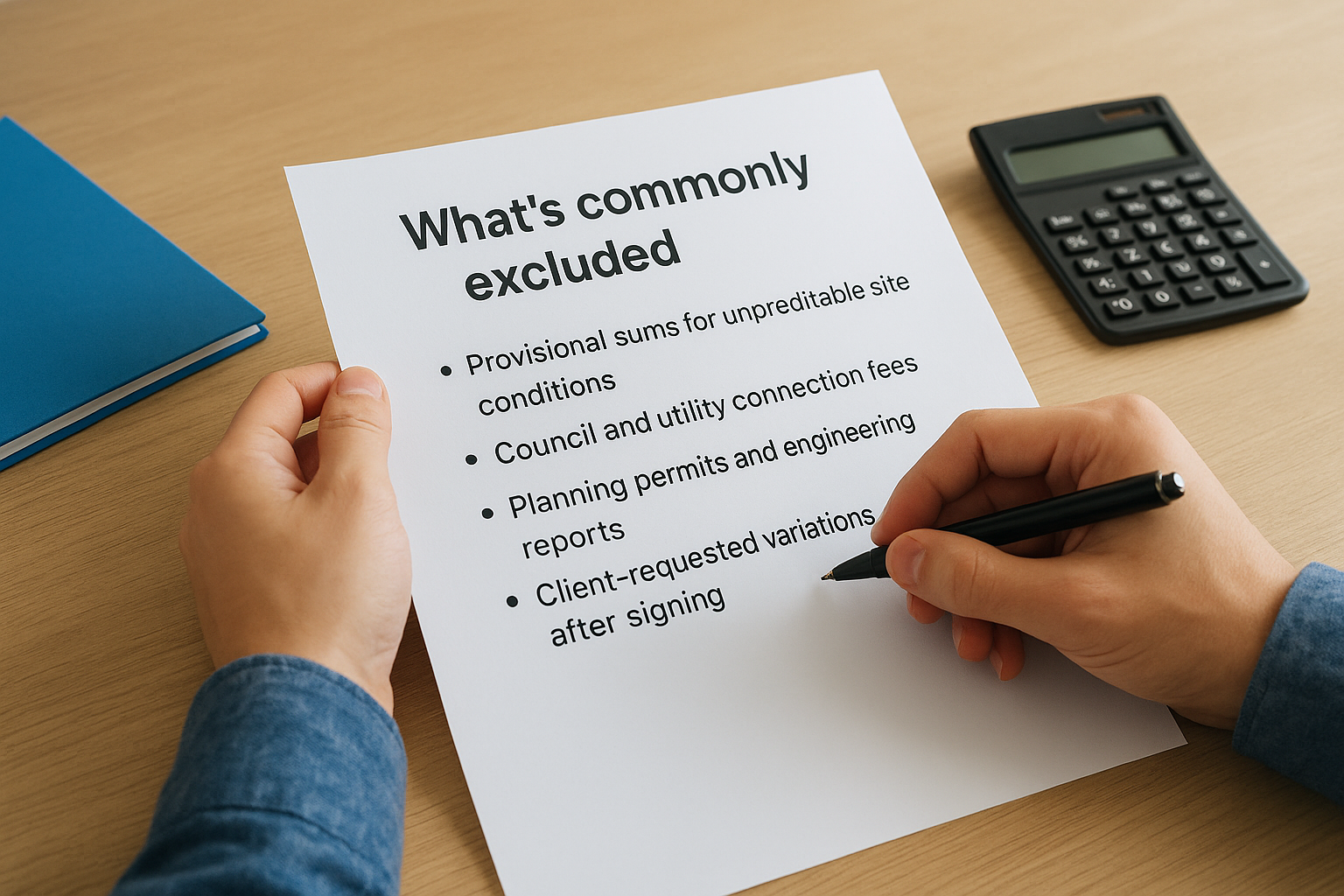
- Provisional sums for unpredictable site conditions such as unexpected soil types
- Council and utility connection fees
- Planning permits and engineering reports
- Client-requested variations after signing
Always ask your builder to walk you through every exclusion line by line before you commit.
Pros and cons for homeowners and builders
Understanding what is a fixed price contract in construction means weighing both sides honestly. No contract type is perfect, and fixed price agreements carry genuine advantages and real limitations depending on your situation and risk tolerance.
Benefits you get from a fixed price contract
Fixed price contracts give you budget certainty from day one. You know the number before construction starts, which makes financing straightforward and planning realistic. For most homeowners, this predictability is the single biggest reason to choose this structure.
Budget certainty often reduces stress far more than any other factor during a long build.
Builders benefit too, because the agreed scope is clearly documented, which reduces disputes and gives the project team a firm delivery target to work toward.
Limitations to keep in mind
Fixed price contracts work best when your scope is fully defined upfront. If your plans are incomplete or your finishes are undecided, the builder has to estimate, introducing provisional sums or allowances that can push your final cost above the headline figure.
For builders, tight pricing without adequate contingency creates financial pressure mid-build, which can affect quality and timelines. Both parties benefit when the contract reflects a realistic and well-researched price.
Fixed price vs cost-plus and other contracts
Knowing what is a fixed price contract in construction becomes much clearer when you compare it directly to the alternatives. Each contract type distributes risk differently, and choosing the wrong structure for your project can create financial problems that are difficult to reverse once construction starts.
Cost-plus contracts explained
A cost-plus contract means you pay the actual cost of labour and materials plus an agreed margin for the builder. There is no fixed endpoint, so your final bill reflects real-time market prices. This structure suits projects where the full scope genuinely cannot be defined upfront, such as complex heritage renovations with unpredictable structural conditions.
Cost-plus contracts shift financial risk back to you, so your budget needs to have genuine flexibility built in.
Which structure suits your project
Fixed price contracts work best when your plans and finishes are fully documented before you sign. If you have completed drawings, a signed-off finishes schedule, and a clear scope, a fixed price agreement gives you maximum budget protection throughout the build. Cost-plus may suit early-stage or highly complex projects, but it requires you to monitor costs actively and maintain a healthy contingency reserve throughout construction. For most standard new builds and renovations, a well-scoped fixed price contract remains the stronger choice for homeowners.
Next steps before you sign
Understanding what is a fixed price contract in construction is the starting point, but acting on that knowledge before you sign is what actually protects your budget. Review your full contract documents carefully, including the finishes schedule, exclusions list, and any provisional sums. If something is vague or undocumented, ask your builder to clarify it in writing before you commit. A few hours spent reviewing the details upfront can save you significant cost and frustration once work starts on site.
Getting your plans and specifications as detailed as possible before requesting quotes also gives you far more accurate pricing and stronger contract protection. Bring an independent solicitor or building consultant on board if you have any doubts about the terms. Your contract should give you genuine confidence, not lingering questions. If you’re planning a new home, renovation, or dual occupancy project in Melbourne’s Northern or Western suburbs, talk to the team at Transformer Homes about your next build.
