
Melbourne’s property market keeps pushing homeowners and investors toward smarter ways to use their land. If you’ve been searching for dual occupancy house plans Melbourne builders actually deliver well, you’re not alone, it’s one of the most common enquiries we receive at Transformer Homes. The appeal is straightforward: two dwellings on one block, whether that means rental income, housing for extended family, or a solid return on investment.
But not every floor plan suits every block. Orientation, council overlays, and neighbourhood character all shape what you can realistically build in Melbourne’s northern and western suburbs. Choosing the wrong design early on can cost you months in permit delays and thousands in redesign fees.
That’s why we’ve pulled together six dual occupancy house plans that Melbourne owners are choosing right now in 2026. Each one reflects layouts and configurations we build regularly, so you’ll know exactly what’s achievable before you speak to a builder. Let’s get into them.
1. Transformer Homes side-by-side duplex plan
The side-by-side duplex is the most requested layout in our dual occupancy house plans Melbourne range. Two dwellings sit next to each other on the same block, each with its own street frontage, private open space, and front entry. This structure makes subdivision and separate titling straightforward, which is why so many Melbourne owners choose it first.
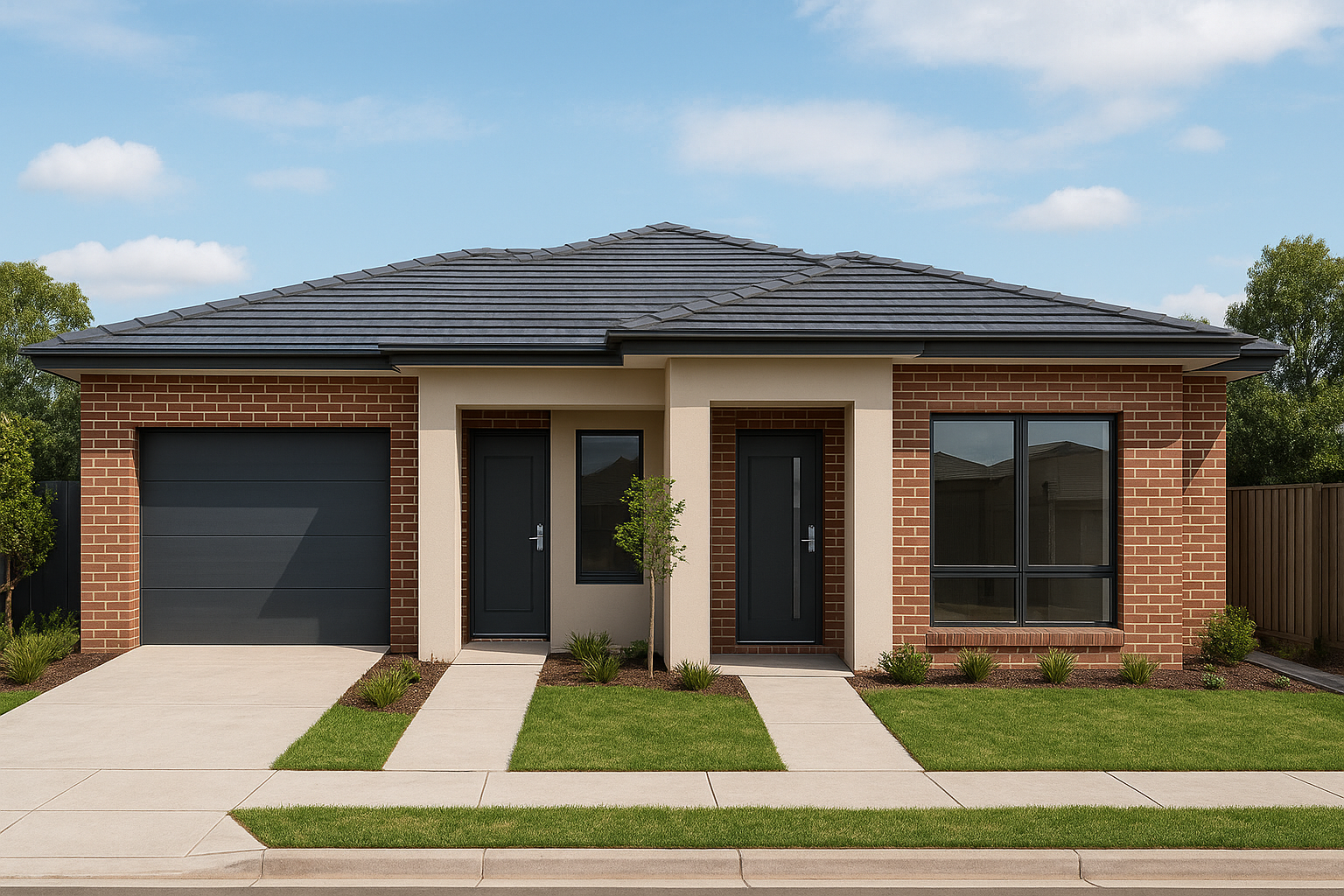
What this plan looks like
Each dwelling in this layout typically carries two or three bedrooms, an open-plan kitchen and living zone, and a single or tandem garage at the front. The shared party wall runs down the centre of the block, keeping both floor plates roughly equal in size. You can mirror the two plans exactly or design them independently to suit different household sizes or target markets.
Best block types for this layout in Melbourne
Your block needs width more than depth for this plan to work well. Sites measuring at least 15 metres wide give each dwelling a comfortable frontage and room for a garage without forcing a tight, awkward entry sequence. Suburbs like Reservoir, Thomastown, and Preston regularly offer blocks in the 600 to 900 square metre range that suit this configuration.
A 15-metre minimum frontage is a common trigger point for side-by-side duplex approval in Melbourne’s northern suburbs, but your local council zone may set a different threshold, so confirm this with a town planner before committing.
Design choices that improve privacy and liveability
Position bedroom windows away from the shared boundary to reduce overlooking issues with your immediate neighbours. A masonry party wall combined with acoustic insulation batts between the two dwellings gives each household real separation rather than just a nominal divide. Staggering the entry doors slightly also prevents the finished product from looking like a single institutional building.
Key Melbourne planning checks to run early
Check ResCode compliance before locking in any floor plan, particularly around side setbacks, rear setback, and private open space minimums. Your local council’s planning scheme will also flag any neighbourhood character overlay or heritage overlay that restricts wall heights, materials, or front setback distances.
Build cost drivers and budget expectations
The party wall and shared services connections are the two biggest cost levers in this design. Splitting a single sewer or stormwater connection internally costs less than running two separate connections to the street. For a standard two-by-three-bedroom side-by-side duplex in Melbourne’s northern suburbs, expect total build costs to sit between $550,000 and $750,000 in 2026, depending on finishes, site conditions, and council requirements.
2. Front and rear dual occupancy plan with shared driveway
A front-and-rear layout places two dwellings on a single block, one behind the other, connected by a shared driveway running along one side. This is one of the most versatile dual occupancy house plans Melbourne owners choose when a side-by-side design simply won’t fit the site.
What this plan looks like
The front dwelling sits at street level with a conventional setback and garden, while the rear unit has its own private courtyard behind it. Both share a single driveway access point from the street, which keeps crossovers to one and simplifies council approval in most zones.
When this layout beats a duplex
Blocks narrower than 14 metres often rule out a side-by-side configuration altogether. A front-and-rear plan works well on longer, thinner sites of 400 to 600 square metres, which are common in suburbs like Coburg, Northcote, and Reservoir.
Confirm with your council whether the rear dwelling needs a minimum private courtyard area, as requirements vary considerably across Melbourne’s northern and western planning schemes.
Parking, driveway width, and turning design
Your driveway needs a minimum clear width of 3 metres to satisfy most Melbourne councils, along with an adequate turning area near the rear garage. Poor turning design is one of the most frequent reasons permit applications stall, so get a traffic engineer’s input before your plans are finalised.
Private open space and overlooking controls to watch
The rear dwelling carries the greatest overlooking risk from upper-floor windows on the front building. Position first-floor bedroom and living windows carefully, or use screening and obscured glazing to satisfy ResCode requirements without sacrificing natural light.
Build cost drivers and budget expectations
Shared driveway construction and separate stormwater drainage for each dwelling are the main cost drivers in this configuration. Budget $500,000 to $700,000 for a typical front-and-rear dual occupancy in Melbourne’s northern suburbs, with site conditions and finish levels shifting the final number.
3. Corner block dual occupancy plan with separate street access
Corner blocks give you something most Melbourne sites simply cannot: two separate street frontages from a single title. That extra frontage means each dwelling can have its own driveway, letterbox, and entry, making both homes feel genuinely independent rather than bolted together.
What this plan looks like
Each dwelling faces a different street, so residents never share an access point. One unit sits at the primary street frontage, while the second faces the side street. Both carry separate garages, private open space, and utility connections, which simplifies future subdivision into individual lots.
Why corner blocks simplify access and street appeal
Two street frontages resolve the biggest headache in most dual occupancy house plans Melbourne owners encounter: shared driveway conflicts. Each dwelling presents its own facade to a public street, which strengthens street appeal and makes individual sales or leasing far more straightforward.
Corner block sites often carry additional planning controls around fencing height near the intersection, so confirm these rules with your council before you finalise any fence line.
Garage placement, crossovers, and services planning
Keep garage crossovers away from the corner itself, as most Melbourne councils require a minimum setback from intersections. Running gas, water, and electrical connections separately from each street frontage adds upfront cost but eliminates complications if you subdivide later.
Setbacks, sightlines, and fencing rules to confirm
Corner blocks often carry reduced side setback allowances on the secondary street frontage. Confirm the exact sightline triangle and fencing height rules at the intersection with your council before your plans are drawn up.
Build cost drivers and budget expectations
Two separate crossovers and independent services connections push costs above a shared-driveway layout. Budget $530,000 to $720,000 for a corner block dual occupancy in Melbourne’s northern or western suburbs, with site conditions and finish levels adjusting that range.
4. Single-storey dual occupancy plan for downsizers
Single-level dual occupancy suits blocks with generous site coverage allowances and owners who want to avoid stairs entirely. Downsizers looking to stay in their suburb while reducing maintenance often find this layout matches their lifestyle and their budget better than a two-storey design.
What this plan looks like
Each dwelling sits on one level, with open-plan living, two bedrooms, and a single garage arranged to maximise natural light and cross-ventilation. Wide corridors and step-free entries make the layout comfortable to live in now and straightforward to adapt as mobility needs change.
How single-storey designs change feasibility maths
Single-storey construction costs less per square metre because you eliminate structural floor systems and staircases. The tradeoff is that your site coverage percentage rises quickly, so councils with tight coverage limits may require you to reduce floor area or increase setbacks to gain approval.
Accessibility-led layout moves that add resale appeal
Wider doorways, a hobless shower, and reinforced bathroom walls for future grab-rail installation cost little at build stage but add measurable resale value. Including open-plan living zones with clear circulation paths also attracts buyers well beyond the downsizer market.
Planning for accessibility from the start costs a fraction of retrofitting later, and it widens the future buyer and tenant pool for both dwellings.
Overshadowing and site coverage issues to anticipate
A large single-storey footprint can shadow neighbouring gardens more than a two-storey building with a smaller floor plate. Confirm your site coverage and overshadowing calculations against your council’s planning scheme before you finalise any dual occupancy house plans Melbourne builders submit for permit.
Build cost drivers and budget expectations
Slab size and landscaping for two separate private open space areas are the main cost drivers in this layout. Budget $480,000 to $660,000 for a single-storey dual occupancy in Melbourne’s northern and western suburbs, with block dimensions and finish selections shifting the final figure.
5. Split-level dual occupancy plan for sloping blocks
Sloping sites challenge most standard floor plans, but a split-level design turns the gradient into an asset. Rather than flattening the block entirely, this layout steps each dwelling down with the natural fall of the land, reducing structural costs and preserving the site’s character.
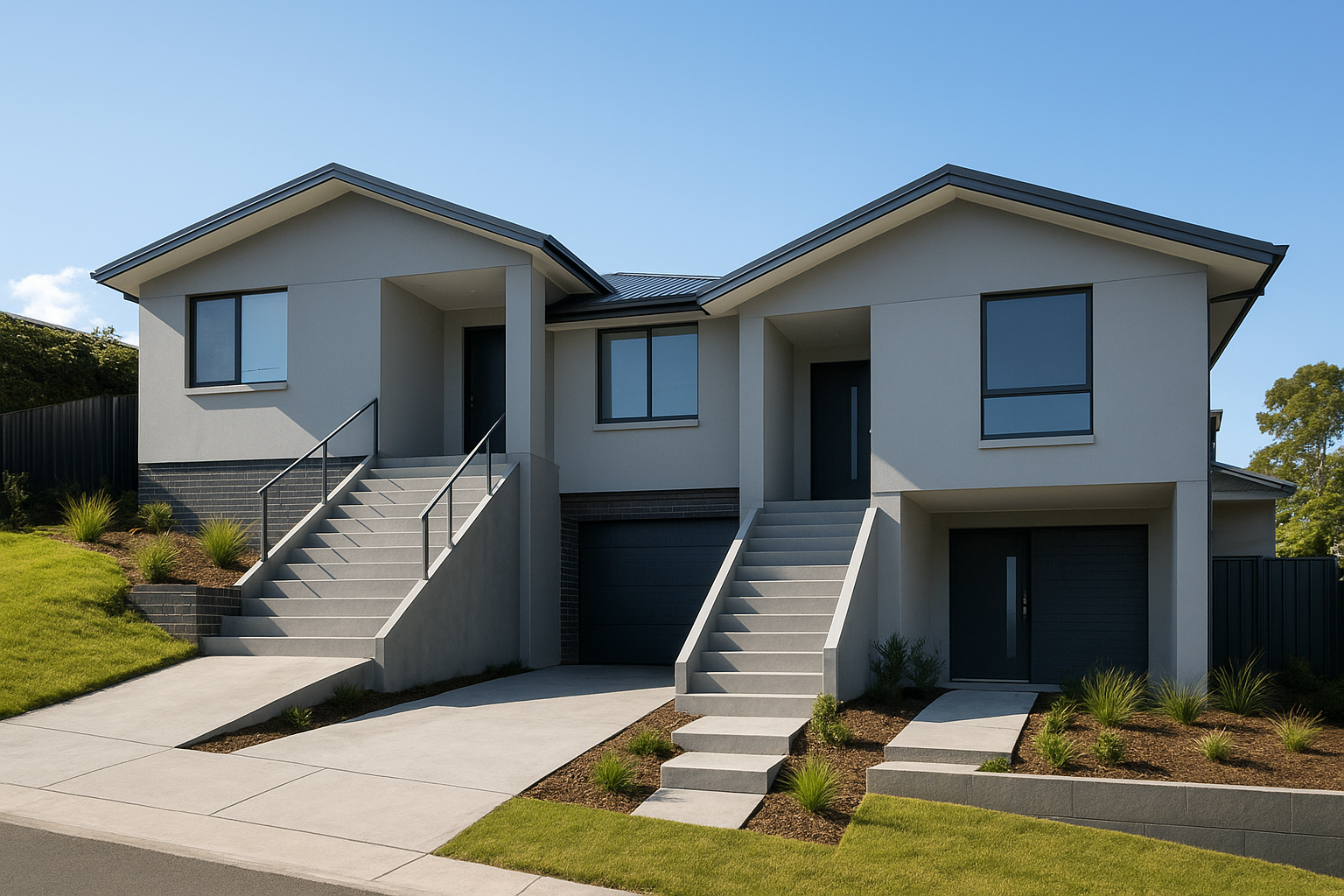
What this plan looks like
Each dwelling sits on a different level of the slope, with internal stairs connecting zones across half-levels or full-level drops. The stepped profile creates distinct living and sleeping zones that feel separated without adding square metres, which suits both owner-occupiers and investors targeting the rental market.
How split levels reduce cut and fill and retaining
Excessive earthworks inflate your budget quickly. A well-designed split-level plan minimises the volume of soil moved, directly reducing retaining wall heights and excavation costs. Your structural engineer and builder should review the natural fall early to align the split points with the terrain rather than fighting it.
Getting a contour survey done before your designer draws anything saves you from approving plans that carry unexpected retaining costs later.
Stair planning, ceiling heights, and natural light strategy
Thoughtful stair placement between levels opens up ceiling height variations that pull natural light deep into the plan. Highlight windows and clerestory glazing at level transitions capture sunlight that a flat-floor design would miss entirely.
Drainage, stormwater, and soil report impacts
Sloping blocks concentrate stormwater runoff toward the lower boundary, so your drainage design must redirect flow before it reaches neighbouring properties. A geotechnical soil report confirms whether the slope involves reactive soils or rock, both of which affect your footing design and cost significantly.
Build cost drivers and budget expectations
Retaining walls, stepped footings, and additional stair construction push split-level builds above a flat-site equivalent. Budget $560,000 to $760,000 for a split-level dual occupancy in Melbourne’s northern and western suburbs, adjusting for the dual occupancy house plans Melbourne builders adapt for sloped conditions.
6. Dual living plan for multigenerational households
A dual living plan keeps two generations under one roof while giving each household enough separation to live independently. Unlike other dual occupancy house plans Melbourne owners choose primarily for investment, this layout prioritises daily comfort for families sharing costs, childcare, or aged care responsibilities.
How to separate entries, living zones, and utilities
Each household needs its own front door and dedicated living area so daily routines don’t collide. Separating utility meters for electricity and gas from the start also avoids ongoing disputes over shared bills and simplifies things considerably if the arrangement ever changes.
Soundproofing and shared-wall design essentials
The shared wall carries sound more than any other element in this plan. Staggered stud framing and acoustic insulation batts in the party wall reduce noise transfer significantly. Positioning bedrooms away from shared kitchen and living areas on either side of the wall reinforces that separation further.
Investing in acoustic performance at frame stage costs far less than retrofitting soundproofing after handover.
Fire safety and services separation questions to ask
Your certifier will require fire-rated construction at the shared wall to meet the National Construction Code. Ask your builder early whether individual smoke alarm systems and emergency egress paths are designed for each dwelling independently before plans are locked in.
Build cost drivers and budget expectations
Internal acoustic upgrades and separate utility connections are the two biggest cost additions in this layout. Budget $510,000 to $700,000 for a dual living build in Melbourne’s northern and western suburbs, with finish level and block conditions adjusting that range.
Ready to choose a dual occupancy plan
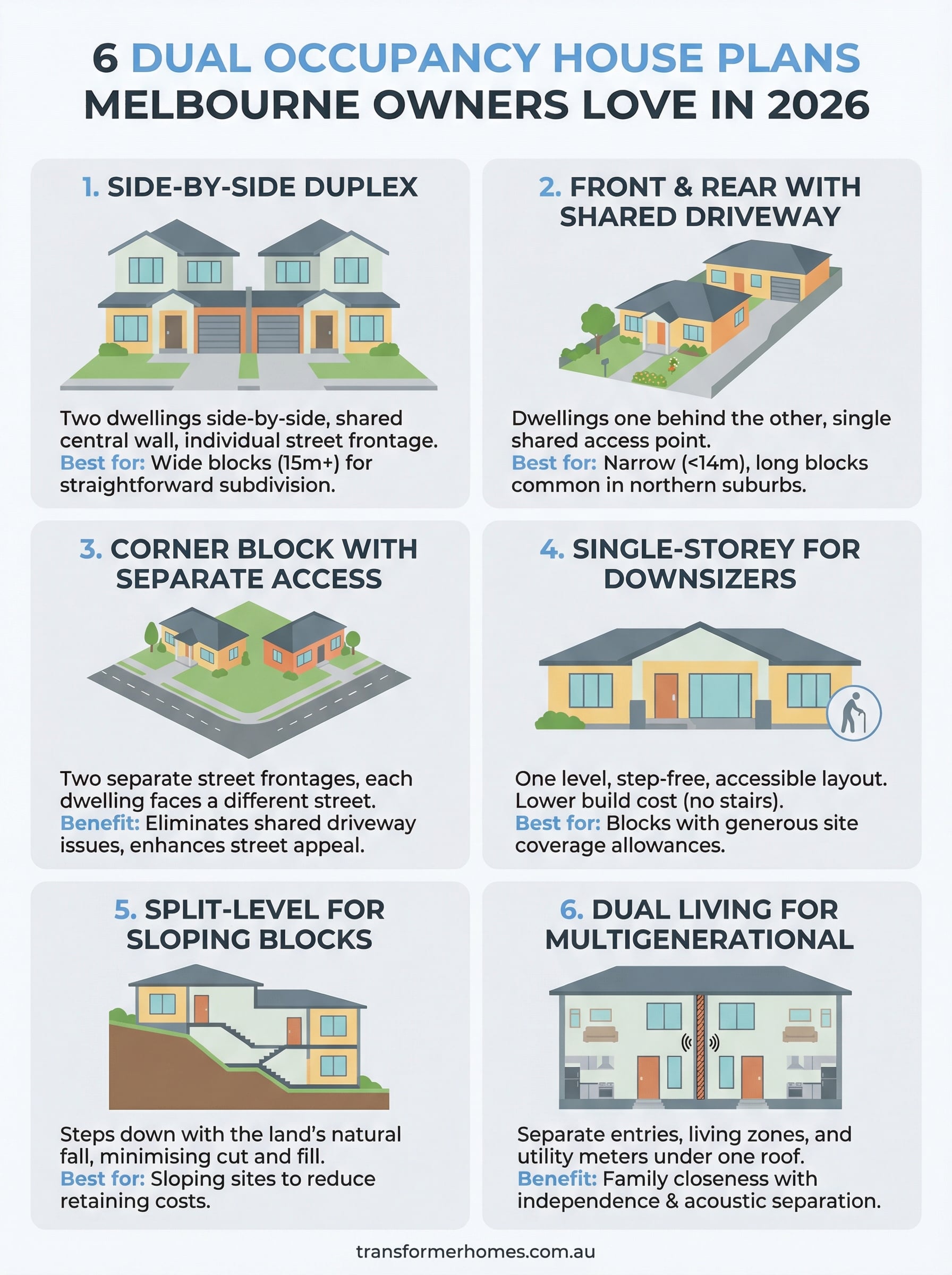
Each of the six layouts above solves a different problem. Side-by-side duplexes suit wide blocks with strong subdivision potential, while front-and-rear and corner block plans handle narrower or more uniquely shaped sites. Single-storey designs serve downsizers, split-level plans tackle sloping terrain, and dual living layouts keep families together without sacrificing independence.
Your next step is matching your specific block to the right plan. Block dimensions, council overlays, and your financial goals all point toward one configuration over the others, and getting that match right early saves significant time and money in the permit stage.
Choosing from the available dual occupancy house plans Melbourne builders can actually deliver starts with a conversation about your site. If you’re ready to move forward, talk to the Transformer Homes team today. We’ll review your block, walk through your goals, and point you toward the layout that fits your land and your budget.
