
If you’re planning to add space to your home, one of the first questions you’ll ask is: what does a home extension cost in Melbourne right now? It’s a fair question, and one without a single clean answer. Costs shift depending on the type of extension, the size, your site conditions, and the level of finish you’re after. What we can do is give you realistic figures based on what we’re seeing in 2026, so you can budget with confidence rather than guesswork.
At Transformer Homes, we build and renovate homes across Melbourne’s northern and western suburbs. We’ve priced, planned, and delivered enough extensions to know where the money goes, and where people get caught off guard. That hands-on experience is exactly what shaped this guide. You won’t find vague ranges pulled from national averages here. Instead, we’ve broken down current per-square-metre rates, typical project totals, and the variables that push costs up or bring them down.
Whether you’re weighing up a ground-floor addition or a second-storey extension, this guide walks you through what to expect at each stage, from early estimates through to final costs. We’ll also cover hidden expenses, council-related fees, and how to get the most value from your build budget.
Typical home extension costs in Melbourne in 2026
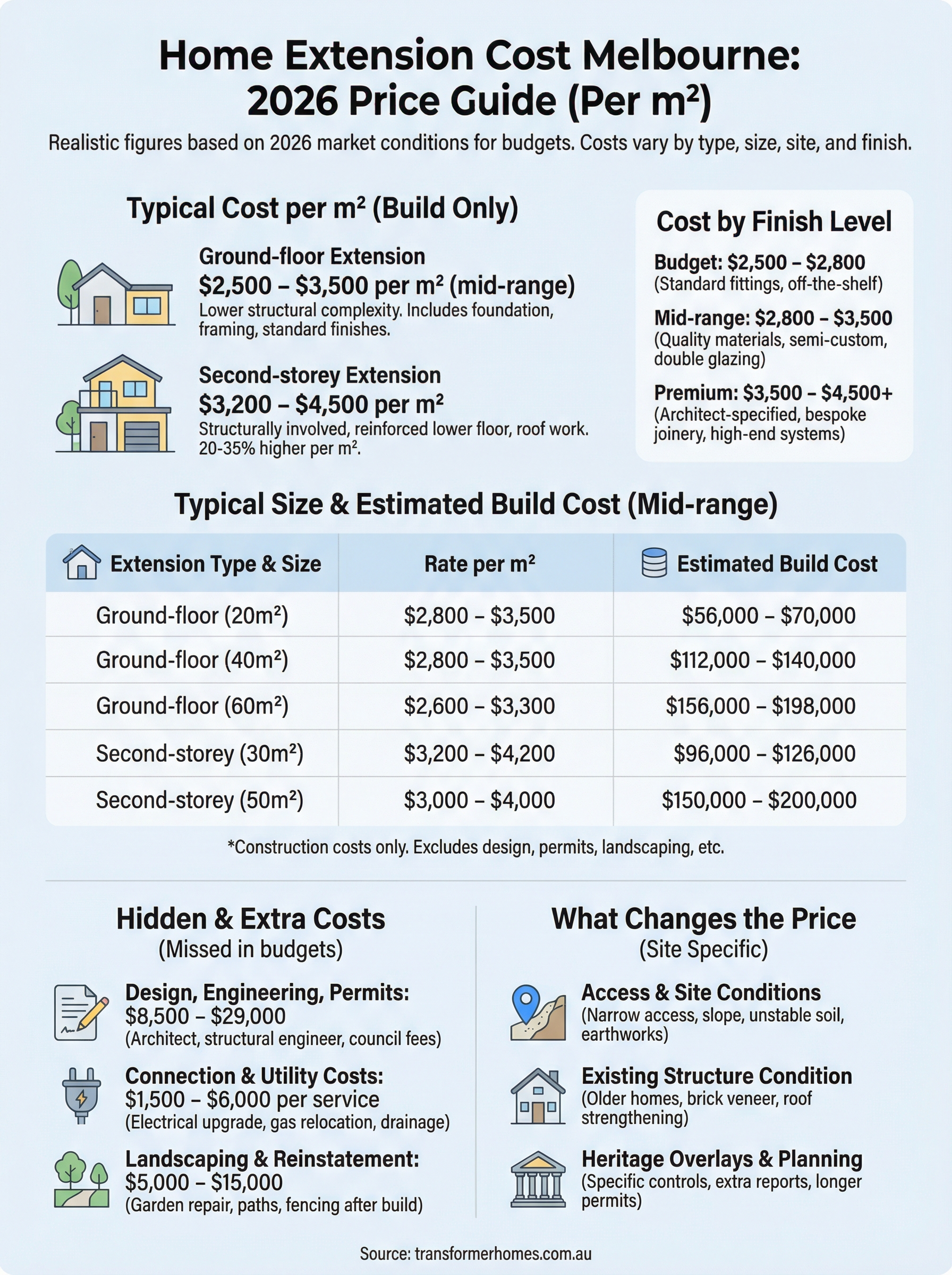
When people start researching home extension cost Melbourne, they often find a wide spread of figures that are hard to make sense of. In 2026, you should budget $2,500 to $4,500 per square metre for most residential extensions in Melbourne, depending on the type and finish level. That range covers the build itself but not every associated cost, which we’ll cover later in this guide.
Ground-floor extensions
Ground-floor additions are the most common type of extension in Melbourne’s established suburbs. They extend the footprint of your home into the backyard or side setback, and they carry lower structural complexity than going up a level. For a standard single-storey extension with a mid-range finish, expect to pay between $2,500 and $3,500 per square metre.
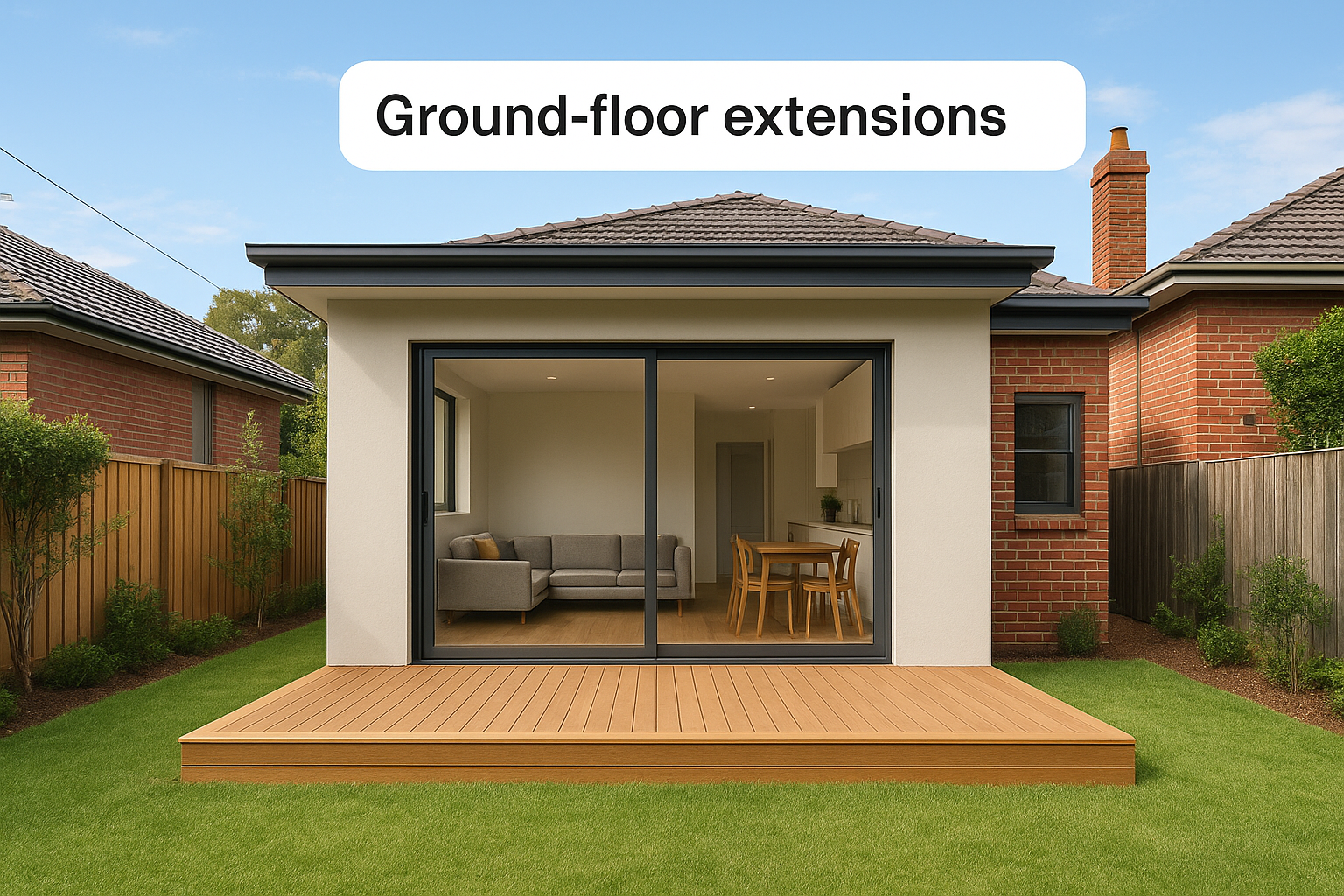
A 40m² ground-floor extension at that rate lands roughly between $100,000 and $140,000 for construction alone. Targeting higher-end finishes, custom joinery, or engineered stone can push the rate to $3,800 per square metre or more. Smaller extensions often cost more per square metre because fixed costs like scaffolding and site setup are spread across fewer metres.
Second-storey extensions
Adding a second storey is structurally more involved than a ground-floor addition. You’re working with the existing roof structure, reinforcing the ground floor to carry new load, and managing a build that requires careful sequencing. These factors push the per-square-metre rate up to $3,200 to $4,500, and sometimes higher for complex sites or luxury finishes.
A second-storey extension typically costs 20 to 35% more per square metre than an equivalent ground-floor addition once all structural and engineering costs are factored in.
A 30m² second-storey addition therefore sits in the range of $96,000 to $135,000 for the build itself, before you add engineering fees, permits, and temporary accommodation if the works require you to vacate. Most Melbourne homeowners who take this path budget at least $120,000 to $180,000 all-in for a modest upper-floor addition.
Extension size and cost: a quick reference
The table below helps you sense-check whether a quote is in the right ballpark. Figures are based on mid-range finishes and Melbourne 2026 market conditions.
| Extension type | Size | Rate per m² | Estimated build cost |
|---|---|---|---|
| Ground-floor | 20m² | $2,800–$3,500 | $56,000–$70,000 |
| Ground-floor | 40m² | $2,800–$3,500 | $112,000–$140,000 |
| Ground-floor | 60m² | $2,600–$3,300 | $156,000–$198,000 |
| Second-storey | 30m² | $3,200–$4,200 | $96,000–$126,000 |
| Second-storey | 50m² | $3,000–$4,000 | $150,000–$200,000 |
These figures represent construction costs only and exclude design fees, engineering, council permits, landscaping, and service connections, all of which add to your final number.
Cost per m² by extension type and finish
The per-square-metre rate you pay depends heavily on the level of finish you specify. When comparing home extension cost Melbourne quotes, two projects of equal size can look very different on paper because one includes laminate benchtops and standard tiles while the other features stone surfaces and custom joinery throughout. Understanding what each finish tier includes helps you spot whether a quote reflects your brief or something well below it.
Budget finish ($2,500–$2,800 per m²)
At this level, you’re working with off-the-shelf products and standard fittings. Flooring is typically vinyl plank or basic tiles, windows are aluminium single-glazed, and cabinetry uses flat-pack or builder-grade options. For a straightforward ground-floor addition, budget finishes can be a practical choice if the extension is mostly functional space, like a laundry or additional bedroom without heavy wet areas.
Budget finishes are only worth pursuing if you’re comfortable replacing key elements within five to ten years as products at this tier tend to wear faster.
Mid-range finish ($2,800–$3,500 per m²)
This is where most Melbourne homeowners land when they want quality without stretching into luxury territory. Mid-range typically includes double-glazed windows, engineered timber or quality tile flooring, stone benchtops in wet areas, and semi-custom cabinetry. It’s a finish level that holds up well over time and photographs well when you eventually sell.
Premium finish ($3,500–$4,500+ per m²)
Premium extensions use architect-specified materials, bespoke joinery, and high-performance glazing systems. You’ll also see features like hydronic heating, integrated appliances, and detailed ceiling work at this level. These finishes are common in Melbourne’s inner northern suburbs where surrounding property values support the investment and buyers expect a polished result.
Extra costs people miss in budgets
When you’re working out home extension cost Melbourne figures, most people focus on the build rate and multiply by square metres. That number is a starting point, not a final budget. Several costs sit outside the construction contract, and they add up fast if you don’t plan for them from the beginning.
Design, engineering, and permits
Your architect or building designer typically charges between $5,000 and $20,000 depending on the complexity of the project and the level of documentation required. On top of that, a structural engineer needs to assess load paths and connections, which adds another $2,000 to $5,000. Council permit fees in Melbourne generally run from $1,500 to $4,000, though some councils charge a percentage of the project value, so large builds attract higher fees.
Always ask your builder to confirm which fees are included in the contract and which you need to pay separately before you sign anything.
Connection and utility costs
Extending your home often means relocating or upgrading services. If your electrical switchboard is at capacity, you’ll need an upgrade before the new lights and circuits go in. Moving gas lines, installing new drainage, or upsizing stormwater connections can each add $1,500 to $6,000 to your project. These costs only become clear once a plumber or electrician inspects the site.
Landscaping and reinstatement
Builders access the rear of your home through the yard, which means concrete paths, garden beds, and fencing take a beating during construction. Reinstating a basic garden after a ground-floor addition typically costs $5,000 to $15,000, depending on what was there before and what condition it’s in when the build wraps up. If you’re planning to landscape properly rather than patch, budget separately for that scope from the start.
What changes the price on your site
Two projects with identical floor plans and the same finish level can land at very different final numbers because your specific site drives a set of costs that no standard rate per square metre can predict. Before you lock in a budget for home extension cost Melbourne, you need to understand which site factors apply to your property.
Access and site conditions
Narrow side access, sloping blocks, and unstable soil all add cost before a single frame goes up. If your builder can’t get materials through to the rear of the site with a standard bobcat, hand labour and crane lifts replace machine work, and those hours show up in your quote. A sloping block requiring cut-and-fill or a suspended slab can add $10,000 to $30,000 over what a flat site would cost for the same extension.
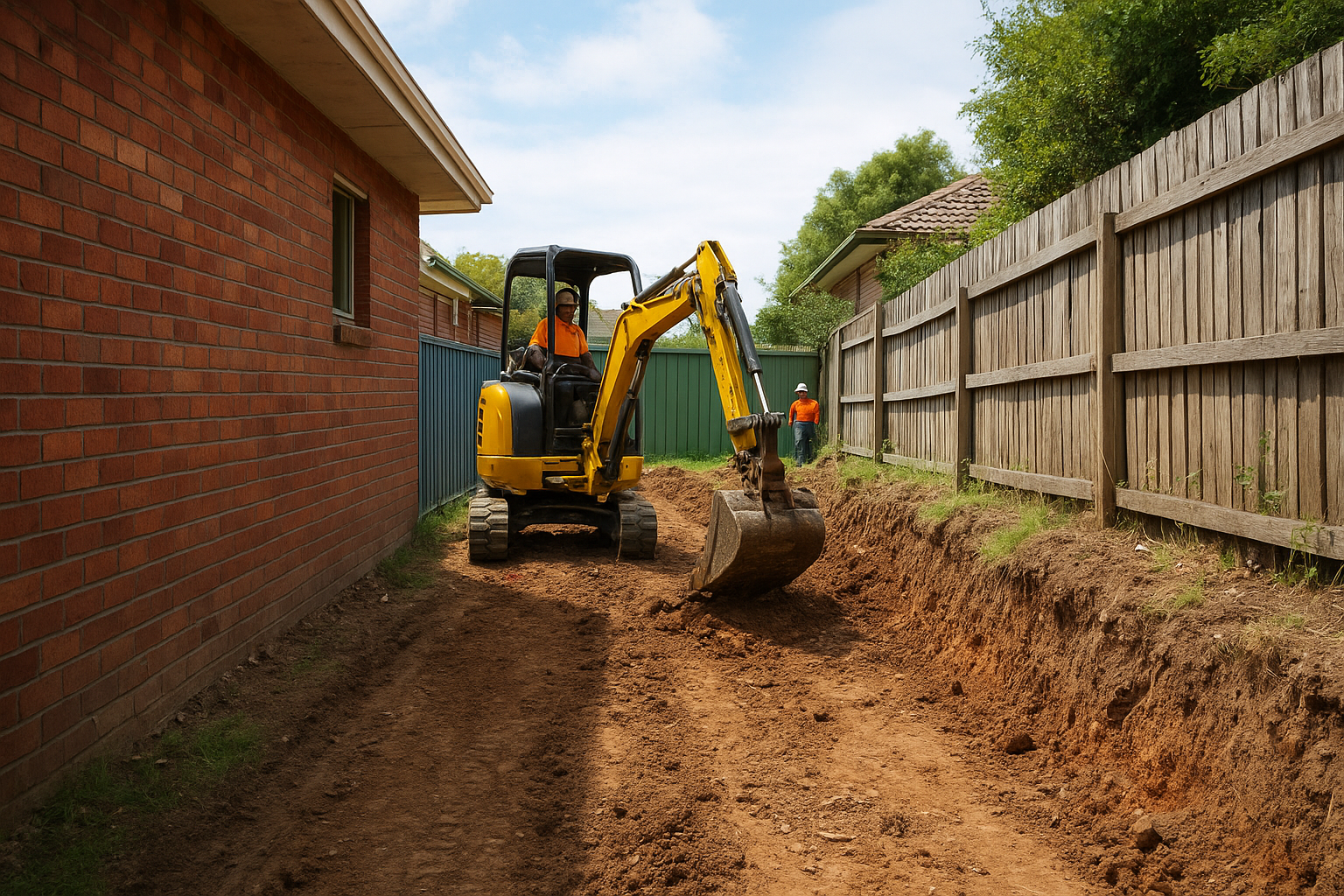
Ask your builder directly how they plan to manage site access and whether the quoted price accounts for any earthworks or temporary works needed to reach the building area.
Soil conditions matter too. If your site has reactive clay or fill material from a previous build, your engineer may require deeper footings or a raft slab system, both of which cost more than standard strip footings.
Existing structure condition
What your extension connects to affects the price significantly. Older homes built before the 1970s often have brick veneer or double brick walls that need to be properly tied into new work, and the existing roof structure may need strengthening before new loads bear down on it.
Heritage overlays and planning restrictions
Some properties in Melbourne’s inner northern and western suburbs sit within heritage overlays or face specific planning controls that shape what you can build and how you build it. These restrictions can require additional reports, modified designs, and longer permit timelines, all of which carry a cost.
How to estimate your extension and compare quotes
Before you contact a single builder, put your own rough number together first. When you walk into a conversation already knowing your approximate budget, you’ll get a more useful response from builders and you’ll be less likely to accept a quote that undersells the scope. Use the per-square-metre rates from this guide to build a working estimate, then add 15 to 20 percent as a contingency to cover the site-specific variables and unexpected conditions that regularly surface during construction.
Build your own rough estimate
Start with the floor area you want to add, then pick the rate that matches your finish level from the tables above. Add design, engineering, and permit fees as separate line items, not as part of the construction rate. Then factor in connection costs, landscaping, and any temporary accommodation if the works will make part of your home unusable. Once you have that total, you have a realistic starting point before anyone has quoted you anything.
A well-prepared brief with a realistic budget will attract more accurate quotes because builders won’t need to guess what you’re expecting.
Getting and comparing quotes
When requesting quotes for home extension cost Melbourne projects, always ask each builder to quote from the same documented brief rather than a verbal description. Inconsistent quotes are usually the result of builders pricing different scopes, not different efficiency levels. When you receive quotes back, check the following before comparing numbers:
- What the contract price includes and excludes
- Whether provisional sums are used (and for what)
- The payment schedule and milestone structure
- What warranty and defects liability period applies
Comparing quotes on these terms, rather than just the headline figure, gives you a far clearer picture of what each builder is actually offering and where the risk sits.
Plan your numbers, then design
Most people approach a home extension the wrong way around. They fall in love with a design concept and then try to fit a budget around it, which nearly always leads to disappointment or a compromised result. Get your budget clear first, then brief your designer to work within it. Understanding realistic home extension cost Melbourne figures before you speak to an architect means every decision you make from that point is grounded in what your project can actually deliver.
Your contingency is not optional. Set aside 15 to 20 percent of your total estimate before you commit to anything, because site surprises, service upgrades, and scope adjustments are standard parts of any extension project. Once you have a solid number, you’re in a strong position to move forward with confidence. If you’re ready to start planning your extension with a builder who works across Melbourne’s northern and western suburbs, talk to the Transformer Homes team about your project.
