
A kitchen renovation is one of the biggest investments you’ll make in your home, and one of the easiest to get wrong if you don’t plan your spending upfront. Whether you’re updating a tired kitchen in Northcote or gutting a full layout in Preston, having a clear kitchen renovation budget breakdown helps you make smarter decisions before a single tile gets pulled up. Without one, costs creep in fast and the project you imagined at $30,000 somehow lands closer to $60,000.
At Transformer Homes, we manage kitchen renovations across Melbourne’s northern and western suburbs every year. We’ve seen firsthand how budgets blow out, and more importantly, how they stay on track. The difference almost always comes down to understanding where your money actually goes: cabinetry, labour, appliances, benchtops, plumbing, electrical, and the dozens of smaller line items that add up quietly.
This guide breaks down kitchen renovation costs by category and across three budget tiers, basic, mid-range, and luxury, so you can plan with real numbers. We’ll walk through what each component typically costs in Melbourne in 2026, where you can save, and where cutting corners tends to cost you more later. By the end, you’ll have a practical framework to build your own budget with confidence.
What a kitchen renovation budget includes
A proper kitchen renovation budget breakdown covers far more than cabinets and benchtops. Most people underestimate the full scope because they focus on the visible elements and forget the trades, services, and logistics that make the whole thing work. Before you set a number, you need a clear picture of every cost category that will appear on your final invoice, not just the ones you see in a display home.
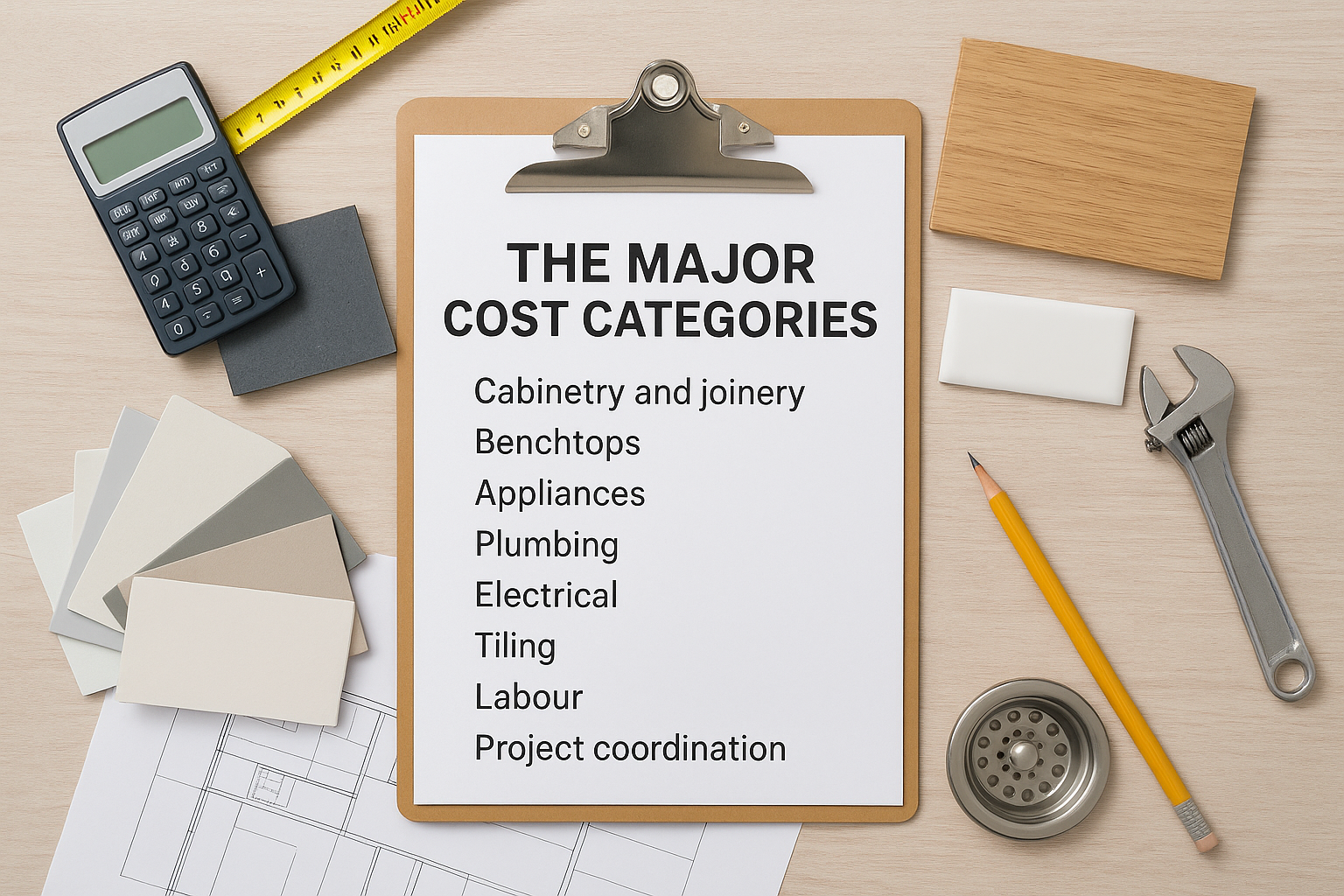
The major cost categories
The core categories in a kitchen renovation are cabinetry and joinery, benchtops, appliances, plumbing, electrical, tiling, labour, and project coordination. Each one draws a different share of your total budget, and the split changes depending on where you land on the budget scale. A basic renovation in Melbourne in 2026 typically runs between $15,000 and $30,000, a mid-range project sits between $30,000 and $70,000, and a luxury renovation starts around $70,000 and goes well beyond $150,000 for full custom builds. The table below shows how your budget typically splits across key categories at each tier:
| Cost Category | Basic ($15k-$30k) | Mid-Range ($30k-$70k) | Luxury ($70k+) |
|---|---|---|---|
| Cabinetry and joinery | $4,000-$8,000 | $10,000-$25,000 | $25,000-$60,000+ |
| Benchtops | $1,500-$4,000 | $4,000-$12,000 | $12,000-$30,000+ |
| Appliances | $2,000-$5,000 | $5,000-$15,000 | $15,000-$40,000+ |
| Plumbing | $800-$2,500 | $2,500-$6,000 | $6,000-$15,000+ |
| Electrical | $800-$2,000 | $2,000-$5,000 | $5,000-$12,000+ |
| Tiling and flooring | $1,500-$4,000 | $4,000-$10,000 | $10,000-$25,000+ |
| Labour and installation | $3,000-$7,000 | $7,000-$18,000 | $18,000-$40,000+ |
| Design and project management | $0-$2,000 | $2,000-$8,000 | $8,000-$20,000+ |
Once you move into mid-range and luxury tiers, cabinetry and benchtops absorb a significantly larger share of the total spend, because material quality scales up faster than most people expect.
Labour and professional fees
Labour is consistently the most underestimated line item in any kitchen renovation. In Melbourne, licensed trades charge between $80 and $180 per hour depending on the discipline, with electricians and plumbers sitting at the higher end. A standard renovation will typically require a cabinet maker or joiner, a plumber, an electrician, a tiler, and a painter. If your project involves structural changes or wall removal, you will also need a registered builder and potentially a structural engineer before work can begin.
Project management fees add another layer on larger jobs. A builder coordinating multiple trades will either charge a percentage of the total build cost (typically 10 to 20 percent) or roll it into a fixed-price contract. Getting coordination included in a fixed contract protects you from cost blowouts when trades run over time or when schedules shift.
Fixtures, fittings, and finishes
This category covers everything that goes inside and on top of your cabinetry: handles, sinks, tapware, rangehoods, splashbacks, and lighting. These items feel small individually, but they add up quickly. A single quality tapware set from a mid-range brand costs between $400 and $1,200, and a full set of handles across 20 cabinet doors can reach $300 to $800 depending on the material and profile you choose.
Your finish selections also drive the benchtop cost significantly. Laminate sits at the low end, engineered stone like Caesarstone sits in the mid-range, and natural stone such as marble or granite pushes costs firmly into the top tier. Knowing your finish preferences before you get quotes lets you compare like for like and stops suppliers from quoting to different specifications.
Step 1. Set your scope and budget range
Before you price anything, you need to decide what you’re actually changing. A cosmetic refresh keeping your existing layout costs a fraction of a structural renovation that moves walls and relocates services. Getting scope right first stops you wasting time collecting quotes that apply to completely different projects.
Define what you’re changing
Your scope determines every cost category that follows. Walk through your kitchen and answer these questions before you speak to any builder or supplier:
- Are you keeping the existing layout, or moving plumbing and electrical points?
- Are any walls being removed or altered?
- Are you replacing just the cabinetry and benchtops, or going back to bare walls?
- Do the appliances stay, or are you replacing everything?
- Is the flooring included, or is it out of scope?
Each "yes, we’re changing that" adds a trade, a material cost, and time to your project. Structural changes such as wall removal require a registered builder and potentially a structural engineer, which shifts your budget tier immediately.
Your scope is your budget’s foundation. Changing it halfway through a build is the single fastest way to burn through your contingency.
Set a realistic number before you get quotes
Once you know your scope, set a target budget range rather than a fixed number. Ranges give builders and suppliers the information they need to quote accurately, and they give you room to make trade-offs as real prices come in. Use this framework to anchor your starting figure:
| Scope Level | What It Typically Includes | Realistic Budget Range |
|---|---|---|
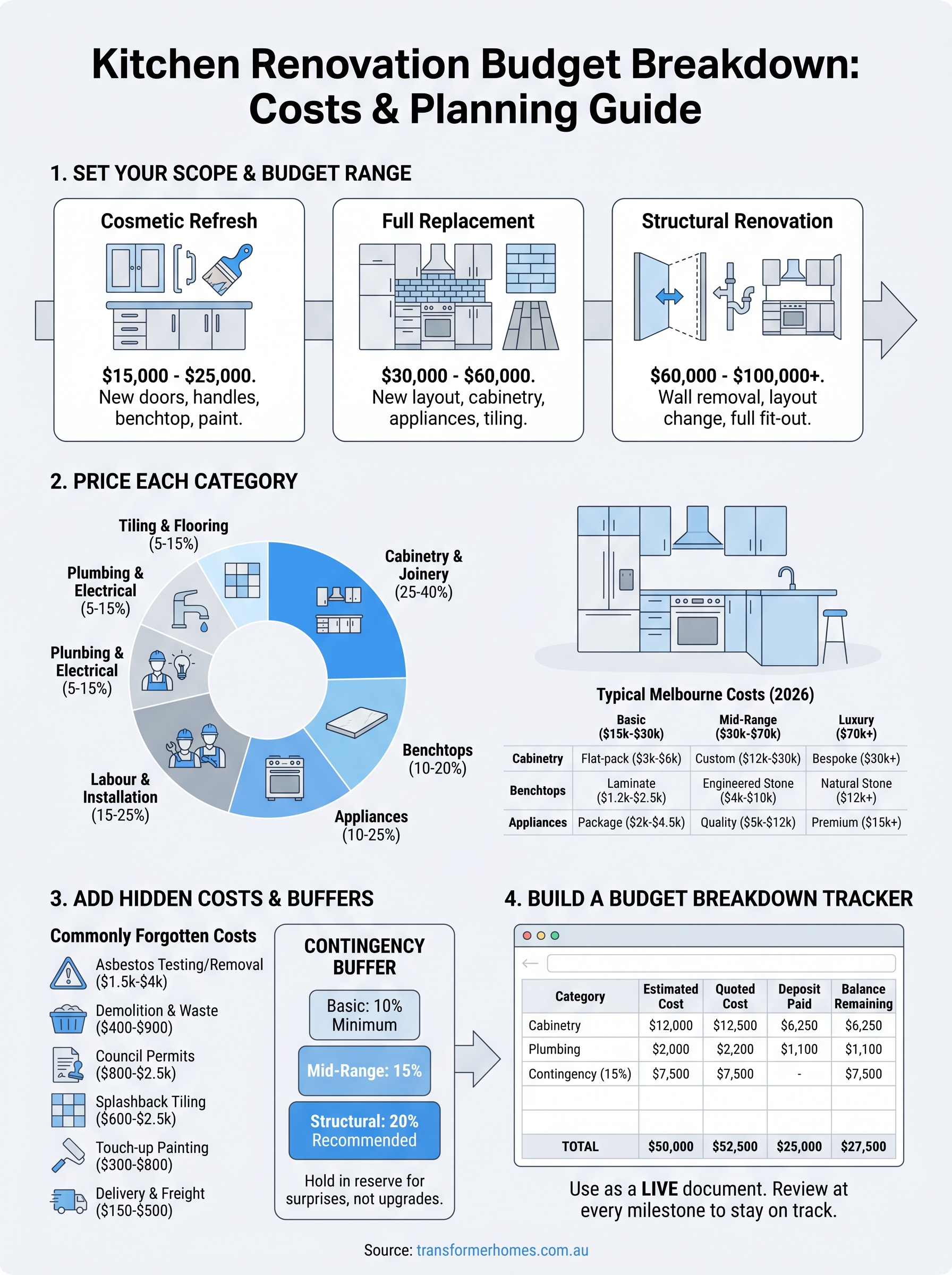
| Cosmetic refresh | New doors, handles, benchtop, and paint | $15,000-$25,000 |
| Full replacement | New layout, cabinetry, appliances, tiling | $30,000-$60,000 |
| Structural renovation | Wall removal, layout change, full fit-out | $60,000-$100,000+ |
Tell every supplier your full range, not just the low end. Quoting to your floor number leads to scope being stripped back to hit a price, which rarely ends well. Sharing your realistic kitchen renovation budget breakdown upfront means every quote you receive reflects the actual project, giving you numbers you can genuinely compare.
Step 2. Price each cost category
Once your scope is locked in, you work through each cost category individually and get at least two quotes per trade or supplier. This is where your kitchen renovation budget breakdown becomes a real document rather than a rough guess. Pricing each category separately stops you from accepting a lump-sum quote that buries savings or inflates margins in areas you can’t see.
Cabinetry, benchtops, and appliances
These three categories typically absorb 50 to 60 percent of your total renovation budget, so they deserve the most attention when you’re collecting prices. Get quotes from both flat-pack suppliers and custom joiners before committing. Flat-pack options from suppliers like IKEA can deliver significant savings on a basic or mid-range renovation, while custom joinery gives you better use of awkward spaces and higher-quality finishes for a luxury result.
Use this pricing reference for Melbourne in 2026 as a starting point when comparing quotes:
| Item | Basic | Mid-Range | Luxury |
|---|---|---|---|
| Flat-pack cabinetry (supply only) | $3,000-$6,000 | $6,000-$15,000 | N/A |
| Custom joinery (supply and install) | $7,000-$12,000 | $12,000-$30,000 | $30,000-$70,000+ |
| Laminate benchtop | $1,200-$2,500 | N/A | N/A |
| Engineered stone benchtop | N/A | $4,000-$10,000 | $10,000-$20,000 |
| Appliance package (oven, cooktop, rangehood) | $2,000-$4,500 | $5,000-$12,000 | $12,000-$35,000+ |
Pricing cabinetry and benchtops separately from installation gives you a clearer read on where your money is going and makes it easier to swap materials without repricing the whole job.
Trades and labour
Each licensed trade quotes separately, which means you need individual prices from your plumber, electrician, and tiler rather than relying on a builder’s rough estimate to cover all three. In Melbourne, expect to pay $90 to $150 per hour for a licensed plumber or electrician and $60 to $100 per hour for a tiler. A standard kitchen renovation with no structural changes typically needs eight to fifteen hours of plumbing and six to ten hours of electrical work.
Collect these quotes in a simple spreadsheet. List each trade, their quoted rate, estimated hours, and total cost. That document becomes your live budget tracker through the entire project.
Step 3. Add the hidden costs and buffers
Most kitchen renovation budget breakdowns fall short not because the visible costs were wrong, but because the hidden costs were never included. This step is where you add the line items that won’t appear in any supplier’s quote but will absolutely show up on your final spend. Building these into your budget before you start is the difference between a renovation that finishes on budget and one that asks you for more money in week three.
The costs most renovations miss
Waterproofing, asbestos testing, and waste removal are three of the most commonly forgotten expenses in a kitchen renovation, and each one can add thousands to your project. Older Melbourne homes built before 1990 may contain asbestos in floor adhesives or wall sheeting, and testing and removal is a licensed process that typically costs $1,500 to $4,000 depending on the extent of the affected area. Waste removal and skip bin hire for a full kitchen strip-out runs $400 to $900. Council permits for structural work add another $800 to $2,500 depending on your local council’s requirements.
Here are the hidden costs you need to line-item before you finalise your budget:
- Asbestos testing and removal: $1,500-$4,000
- Demolition and waste removal: $400-$900
- Council permits (if required): $800-$2,500
- Temporary kitchen setup: $200-$600
- Splashback tiling (often excluded from cabinetry quotes): $600-$2,500
- Touch-up painting and patching after trades: $300-$800
- Delivery and freight for appliances or cabinetry: $150-$500
How to size your contingency buffer
Every renovation budget needs a contingency allocation sitting above your quoted costs, not inside them. For a basic or cosmetic renovation with minimal structural work, 10 percent is your minimum buffer. For a mid-range project with multiple trades, set aside 15 percent. If your renovation involves structural changes, wall removal, or an older home with unknown conditions inside the walls, hold 20 percent in reserve.
Never treat your contingency as a spending pool. It exists to absorb surprises, not to fund upgrades you decide on mid-build.
If you reach practical completion and haven’t touched the buffer, you’ve successfully managed your renovation budget. That is the goal.
Step 4. Build a budget breakdown that stays on track
With your scope set, categories priced, and hidden costs added, you now have everything you need to turn those numbers into a working kitchen renovation budget breakdown. The goal isn’t a static list you glance at before signing contracts and then forget. It’s a live document you update at every key milestone, from the first deposit through to your final invoice. Keeping it current is what stops small budget shifts from becoming large financial surprises.
Set up your budget tracker
Use a simple spreadsheet to organise every cost category into a format you can update as the project moves forward. Each category gets its own row, and each stage of payment gets its own column: your estimate, the quoted price, the deposit paid, and the balance remaining. This layout makes it immediately clear when a quoted figure sits above your estimate, giving you time to negotiate or adjust scope before you’re locked in.

Copy this template directly into a spreadsheet to get started:
| Category | Estimated Cost | Quoted Cost | Deposit Paid | Balance Remaining |
|---|---|---|---|---|
| Cabinetry and joinery | ||||
| Benchtops | ||||
| Appliances | ||||
| Plumbing | ||||
| Electrical | ||||
| Tiling and flooring | ||||
| Labour and installation | ||||
| Design and project management | ||||
| Hidden costs | ||||
| Contingency (10-20%) | ||||
| Total |
Fill in your estimated column before you collect a single quote, so every price you receive has a clear benchmark to measure against.
Review your tracker at every milestone
Your spreadsheet only works if you update it consistently at the points that matter. Review your figures when you sign contracts and pay deposits, when each trade completes their work and issues an invoice, and again at practical completion when final payments clear. Any gap between your estimated and quoted figures is a prompt to revisit your scope or adjust another category, not something to absorb quietly and hope your contingency handles. Treating your tracker as an active management tool rather than a filing exercise is what keeps your renovation financially on course from start to finish.
Wrap it up and move forward
A solid kitchen renovation budget breakdown gives you control over your project from the first quote through to the final payment. You now have a clear view of what each cost category covers, how prices shift across basic, mid-range, and luxury tiers, and which hidden costs catch renovators off guard. The spreadsheet tracker and contingency rules in this guide aren’t optional extras. They’re the tools that keep your spending aligned with your plan when the project is live and decisions need to happen fast.
Planning the numbers is step one. Finding the right builder to execute the work is step two, and that choice matters just as much as any line item in your budget. If you’re renovating in Melbourne’s northern or western suburbs and want a builder who manages your project with full transparency and fixed-price contracts, talk to the team at Transformer Homes before you finalise your scope.
