
If you’re planning a kitchen reno in Melbourne, the first question on your mind is probably: how much is this actually going to cost me? It’s a fair question, and one without a single neat answer. The kitchen renovation cost Melbourne homeowners face in 2026 ranges anywhere from $15,000 for a basic refresh to well over $80,000 for a full high-end transformation. That’s a wide spread, and where you land depends on dozens of decisions you’ll make along the way.
At Transformer Homes, we handle kitchen renovations across Melbourne’s Northern and Western suburbs, from strip-outs in Northcote weatherboards to complete redesigns in newer Preston builds. We see the real numbers every week, what materials actually cost, what trades are charging, and where budgets blow out when there’s no plan in place. That hands-on experience is exactly what shaped this guide.
Below, we’ve broken down 2026 pricing into clear tiers, budget, mid-range, and premium, along with current labour rates, the key factors that push costs up or down, and practical ways to get better value from your build. Whether you’re after a straightforward update or a ground-up kitchen overhaul, this breakdown gives you real figures to plan with before you commit to a single quote.
2026 price ranges for Melbourne kitchen renos
Understanding the kitchen renovation cost Melbourne homeowners face in 2026 starts with knowing the three main pricing tiers. Each tier reflects a different scope of work, quality of materials, and trade involvement. The figures below are based on real projects, not broad industry estimates, so you can use them with confidence when you start planning.
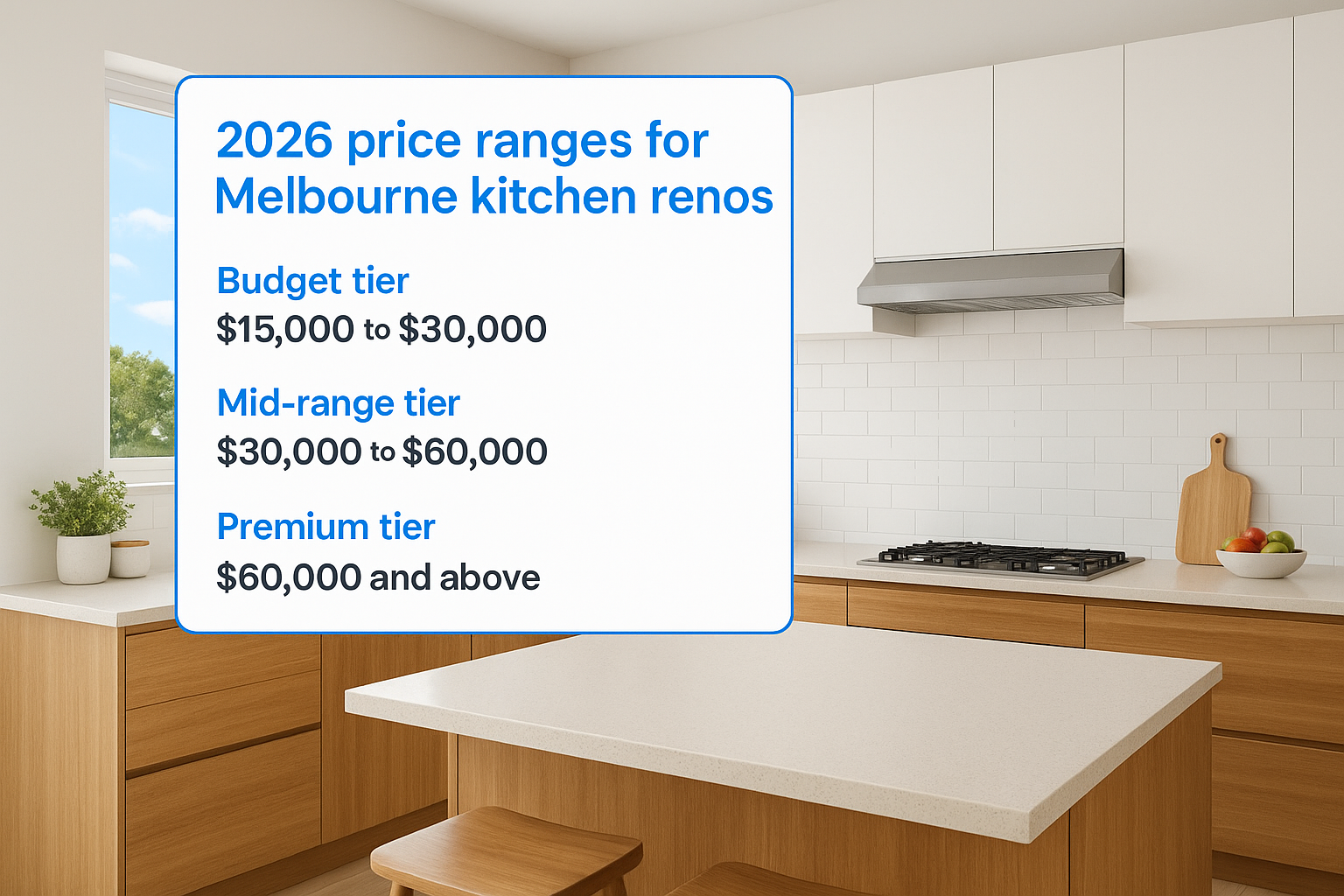
Where you land on the pricing scale has less to do with the size of your kitchen and more to do with the materials you choose and whether the layout is changing.
Budget tier: $15,000 to $30,000
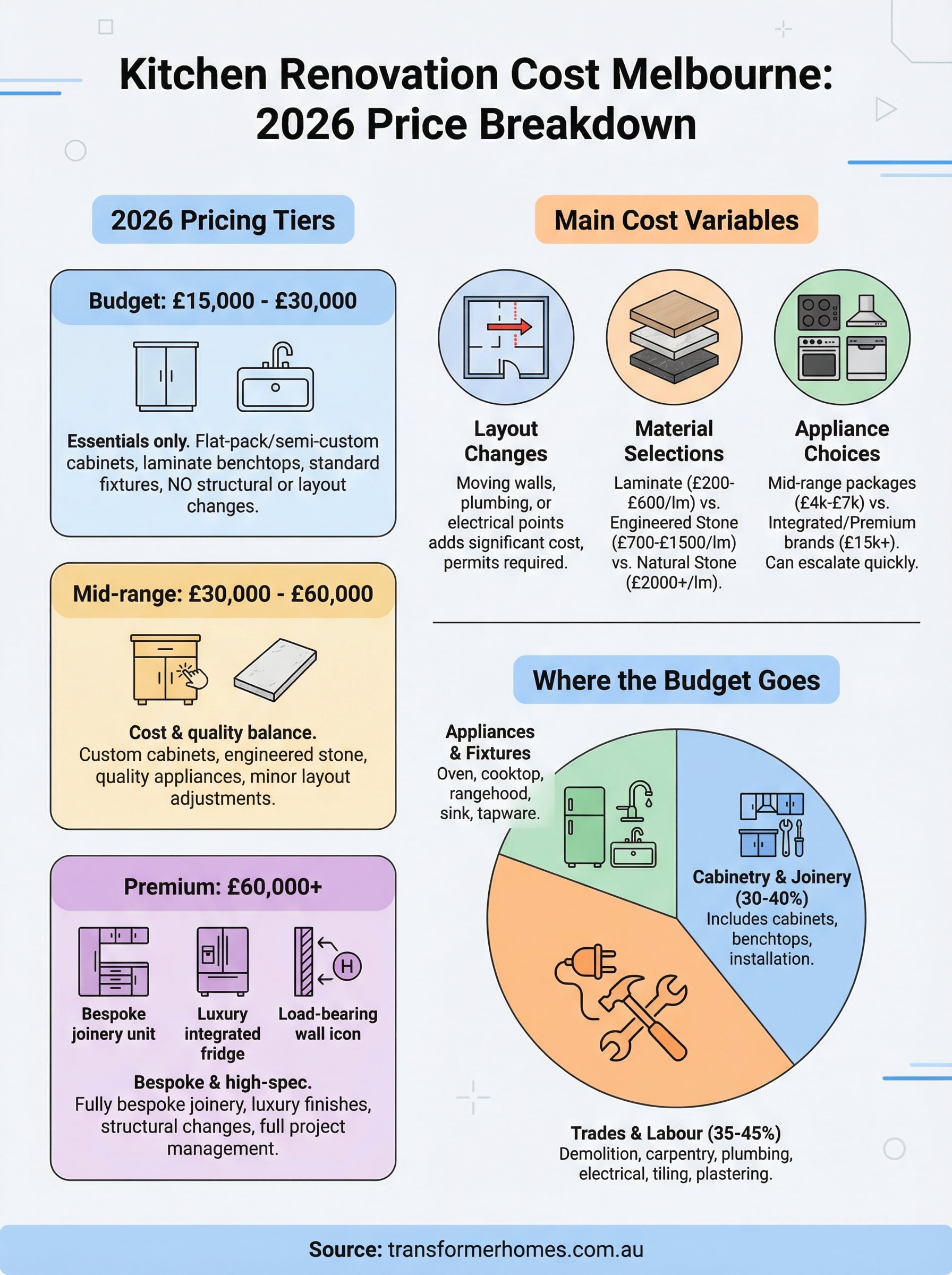
A budget renovation covers the essentials without any structural change. You’re typically working with flat-pack or semi-custom cabinetry, laminate benchtops, and standard fixtures from suppliers like IKEA or Bunnings. Because the layout stays the same, you avoid the cost of rerouting plumbing or moving electrical points, which makes a genuine difference to the final number.
This tier suits kitchens under 10 square metres or investment properties where function and durability matter more than premium finishes. You can still get a clean, practical result at this price point, but it requires careful planning and zero scope changes once work begins.
Mid-range tier: $30,000 to $60,000
Most Melbourne homeowners land somewhere in this range, and it’s where cost and quality start to balance out properly. At this level, you’re looking at semi-custom or fully custom cabinetry, engineered stone benchtops, quality appliances, and updated plumbing and electrical where the layout requires it. You also have enough room in the budget to shift a wall or reposition an island if the flow of the space genuinely needs it.
Soft-close hardware, integrated appliances, and under-cabinet lighting all sit comfortably within this tier. Kitchens renovated at this price point typically run between 10 and 20 square metres and are built to last 15 to 20 years with proper care.
| Tier | Price range | Typical inclusions |
|---|---|---|
| Budget | $15,000 – $30,000 | Flat-pack cabinets, laminate benchtops, basic fixtures, no layout change |
| Mid-range | $30,000 – $60,000 | Custom cabinetry, stone benchtops, quality appliances, minor layout changes |
| Premium | $60,000+ | Bespoke joinery, luxury finishes, structural work, full project management |
Premium tier: $60,000 and above
Premium renovations start at $60,000 and can push well past $100,000 for larger or more complex projects. At this level, you’re investing in fully bespoke joinery, high-specification stone, and top-tier appliances from brands like Miele or Liebherr. Structural changes, including removing load-bearing walls or relocating the kitchen to a different part of the home, are common at this price point and carry their own permit and engineering costs.
These projects also involve a coordinated project management approach, where a single point of contact handles all trades, material deliveries, and inspections from start to finish. The result is a kitchen that adds measurable value to your property and functions exactly the way you’ve designed it to.
What changes the cost the most
When comparing the kitchen renovation cost Melbourne quotes you receive, the biggest variable is rarely the size of the kitchen. Two kitchens of the same square metreage can sit $30,000 apart in price based on three core decisions: whether the layout is changing, what materials you specify, and which appliances you select. Understanding these drivers before you brief a builder puts you in a much stronger position to control your final number.
Layout changes and structural work
Moving a wall, shifting a window, or repositioning the sink to the other side of the kitchen all add cost quickly. Plumbing relocation alone can add $3,000 to $8,000 to a project, and that figure climbs further if you need to move drainage below the slab. Structural changes like removing a load-bearing wall require an engineer’s report and a building permit, which adds both time and direct cost before a single cabinet goes in.
If your current layout functions well, keeping it intact is the single most effective way to control your renovation budget.
Material and finish selections
Your choice of benchtop material has a significant impact on the overall figure. Laminate benchtops sit at $200 to $600 per linear metre installed, while engineered stone typically runs $700 to $1,500 per linear metre. Natural stone like marble or granite can push beyond $2,000 per linear metre. Here is how the main options stack up:
- Laminate: $200 to $600 per linear metre, durable and budget-friendly
- Engineered stone: $700 to $1,500 per linear metre, the most popular mid-range choice
- Natural stone: $2,000+ per linear metre, highest visual impact and highest cost
Appliance choices
Appliances are one area where costs can escalate fast if you don’t set a ceiling early. A solid mid-range cooking package with a 90cm oven, induction cooktop, and rangehood runs roughly $4,000 to $7,000. Step up to integrated refrigeration or a premium European brand and that same category of spend can jump to $15,000 or more.
Locking in your appliance budget before you finalise your cabinetry design keeps the two aligned, since cabinet dimensions are built around your appliance selections and changes made late in the process cost more to fix than to get right from the start.
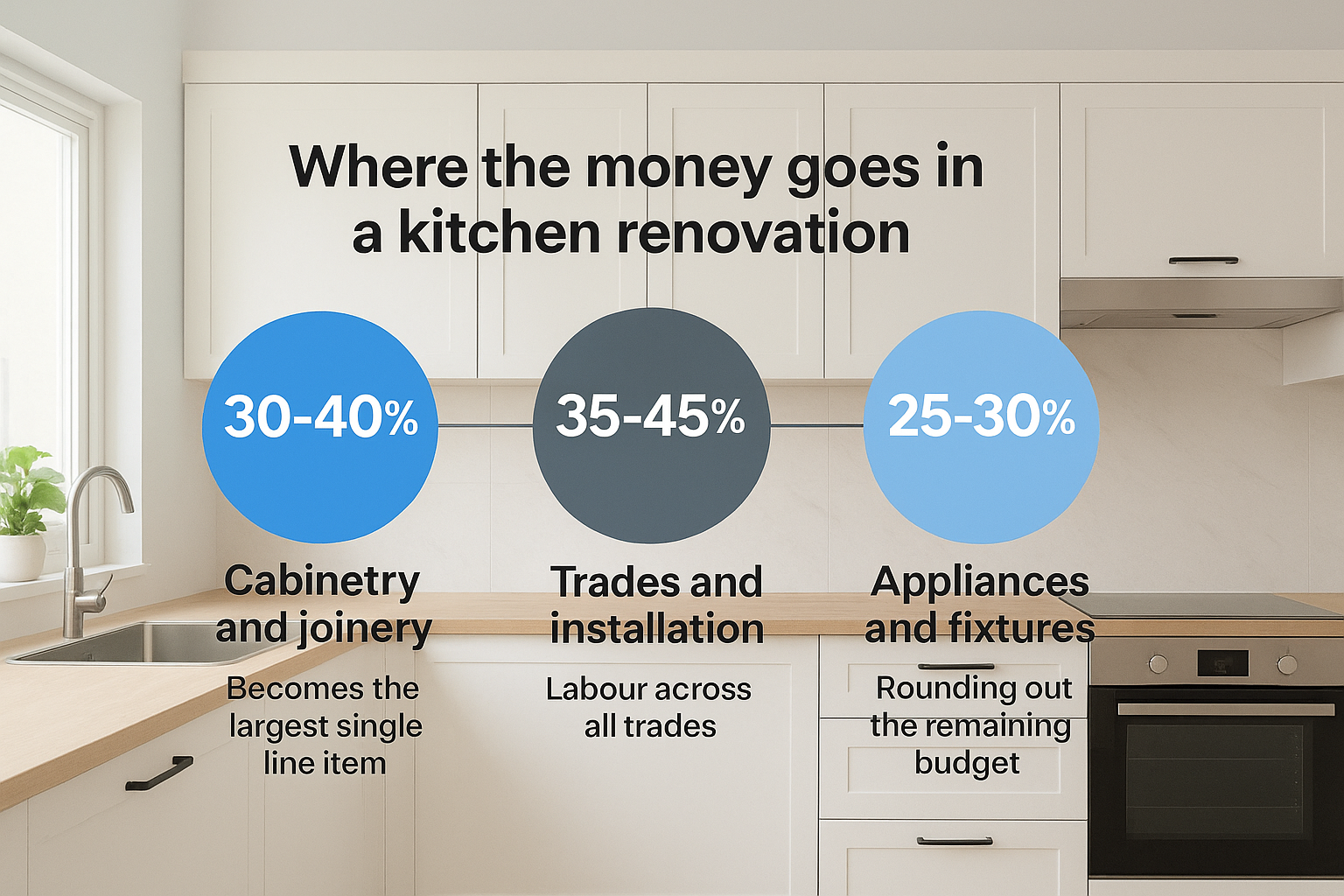
Where the money goes in a kitchen renovation
When you’re mapping out the kitchen renovation cost Melbourne projects typically involve, it helps to understand how your budget actually splits across categories. Most homeowners are surprised to find that cabinetry and joinery alone account for 30 to 40 per cent of the total spend on a mid-range renovation. Knowing the breakdown in advance helps you decide where to invest and where to pull back without affecting the overall quality of the result.
Cabinetry and joinery
Cabinetry is consistently the largest single line item in a kitchen renovation. For a mid-range project, expect to spend between $10,000 and $25,000 on cabinetry depending on whether you go flat-pack, semi-custom, or fully bespoke. The cost gap between flat-pack and custom joinery is significant, but custom work gives you exact dimensions, better hardware, and finishes that outlast cheaper alternatives by years.
Benchtops typically add another $3,000 to $8,000 for engineered stone on a standard kitchen layout. Together, cabinetry and benchtops represent the category where most mid-range budgets are concentrated, so locking in your material selections early keeps the rest of the design from shifting around them later.
Trades and installation
Labour across all trades, including demolition, carpentry, plumbing, electrical, tiling, and plastering, typically accounts for 35 to 45 per cent of the total cost. You can’t reduce this category by finding cheaper trades. Cutting corners on licensed plumbing or electrical work creates compliance issues that cost significantly more to fix after the fact than they would have cost to handle correctly from the start.
Getting all your trades coordinated through a single builder is the most reliable way to keep labour costs predictable and avoid schedule blowouts.
Appliances and fixtures
Appliances, tapware, and sinks round out the remaining budget and typically sit between $5,000 and $20,000 depending on the brands you select. A functional mid-range package covering oven, cooktop, rangehood, and sink is achievable for around $5,000 to $7,000. Upgrading to integrated refrigeration or dishwasher drawers is where this category climbs quickly, so set a firm ceiling here before you finalise your cabinetry design.
Labour rates, timeline and permits in Melbourne
Labour is a fixed reality when you’re calculating the kitchen renovation cost Melbourne builders quote you. Unlike materials, where you can swap one benchtop for another to save money, licensed trade rates in Victoria are largely non-negotiable, and attempting to cut costs by using unlicensed workers puts your insurance and compliance at genuine risk.
Trade labour rates in 2026
Melbourne trade rates have risen steadily over the past two years, driven by sustained demand and a tight labour market across the building sector. Here is what you can expect to pay for the key trades involved in a kitchen renovation in 2026:
- Carpenter/cabinet installer: $80 to $120 per hour
- Licensed plumber: $120 to $180 per hour
- Licensed electrician: $110 to $160 per hour
- Tiler: $70 to $110 per hour
- Plasterer: $70 to $100 per hour
Most kitchen renovations involve four to six different trades, and the coordination between them directly affects how efficiently your project runs. If trades are arriving out of sequence or waiting on each other, your total labour cost climbs without any additional work being completed.
How long a kitchen renovation takes
A budget renovation with no structural work typically takes two to four weeks from strip-out to handover. Mid-range projects, particularly those involving new plumbing runs or cabinetry made to order, run four to eight weeks in most cases. Premium renovations with structural changes can extend to twelve weeks or beyond, depending on permit approval timelines.
The most common cause of timeline blowout is late material deliveries, so confirm lead times on cabinetry and appliances before your builder schedules trades.
Building permits in Melbourne
Not every kitchen renovation requires a building permit in Victoria, but several scenarios trigger the requirement. Structural changes such as removing a load-bearing wall or moving external openings all require a permit through your local council or a private building surveyor. Relocating plumbing within a concrete slab also typically requires a plumbing permit and a compliance inspection before the slab is reinstated.
Permit fees in Melbourne vary by council but generally range from $1,000 to $3,500 depending on the declared scope of work. Build this figure into your budget from the outset rather than discovering it midway through the project.
How to set a budget and avoid blowouts
Setting a realistic budget before you speak to a builder is the most important thing you can do to control the kitchen renovation cost Melbourne projects typically generate. Most blowouts don’t happen because of unexpected disasters. They happen because scope decisions get made during construction, when changes cost two or three times what they would have cost during the planning phase.
Separate your needs from your wants
Before you set a number, write two lists. One for the things your kitchen genuinely needs, like functional cabinetry, compliant electrical, and working appliances, and one for the things you’d like if the budget allows, such as integrated refrigeration or butler’s pantry additions. This separation gives you a clear picture of what your floor-level spend actually is, and what you’re adding on top when the budget permits.
Once you have both lists, price the needs list first with your builder. That figure becomes your baseline, and everything from the wants list gets added only after you’ve confirmed it fits without pushing you past your ceiling.
The homeowners who come in over budget are almost always the ones who added scope mid-project rather than the ones who chose more expensive materials upfront.
Build in a contingency from day one
Every kitchen renovation should carry a contingency of 10 to 15 per cent on top of the quoted figure. This isn’t pessimism. It’s standard practice on any construction project in Melbourne, where hidden issues like water-damaged framing or outdated wiring behind walls are genuinely common, particularly in older homes across the Northern and Western suburbs.
If you finish the project and haven’t touched the contingency, you have money left over. If you don’t build one in, a single unexpected finding can derail your entire timeline and push you into decisions you didn’t plan for.
Lock your selections before work starts
Changes made after your builder has scheduled trades cost more than changes made on paper. Finalise your cabinetry, benchtops, and appliances before the strip-out begins, and confirm lead times on any made-to-order items so trades aren’t waiting on materials mid-project. A fully resolved scope before day one is the most reliable protection against a budget that drifts.
Next steps
You now have a clear picture of what kitchen renovation cost Melbourne projects actually involve in 2026, from the budget tier through to premium builds, including where the money goes and how to keep your project on track. The key takeaways are straightforward: lock in your selections before work starts, build a contingency into your budget from day one, and keep your layout intact unless there’s a genuine functional reason to change it.
Transformer Homes works with homeowners across Melbourne’s Northern and Western suburbs who want a kitchen renovation handled properly, with experienced trades, clear communication, and no nasty surprises midway through a build. If you’re ready to move from planning to an actual quote, we’d be glad to walk through your project with you. Get in touch with the Transformer Homes team to start the conversation and get a realistic figure for your renovation.
