
If you’ve started researching how to build a home that’s designed around your life, not a catalogue, you’ve probably asked yourself what is a custom home builder and whether it’s the right path for you. It’s a fair question, especially when the building industry throws around terms like "custom," "semi-custom," and "project home" as though they all mean the same thing. They don’t, and the differences matter more than most people realise before signing a contract.
A custom home builder works with you to design and construct a home from scratch, tailored to your block, your brief, and your budget. That’s a fundamentally different process from choosing a pre-set floorplan and picking your tiles from a limited range. At Transformer Homes, we build custom-designed homes across Melbourne’s northern and western suburbs, so we see firsthand how often homeowners underestimate the gap between a volume builder and a true custom build, in cost, flexibility, and day-to-day experience.
This article breaks down exactly what a custom home builder does, what the process looks like from first conversation to handover, how costs compare to volume and project builders, and where the real trade-offs sit. Whether you’re building on your own land or still weighing up your options, this guide gives you the clarity you need to make a confident decision.
What a custom home builder does
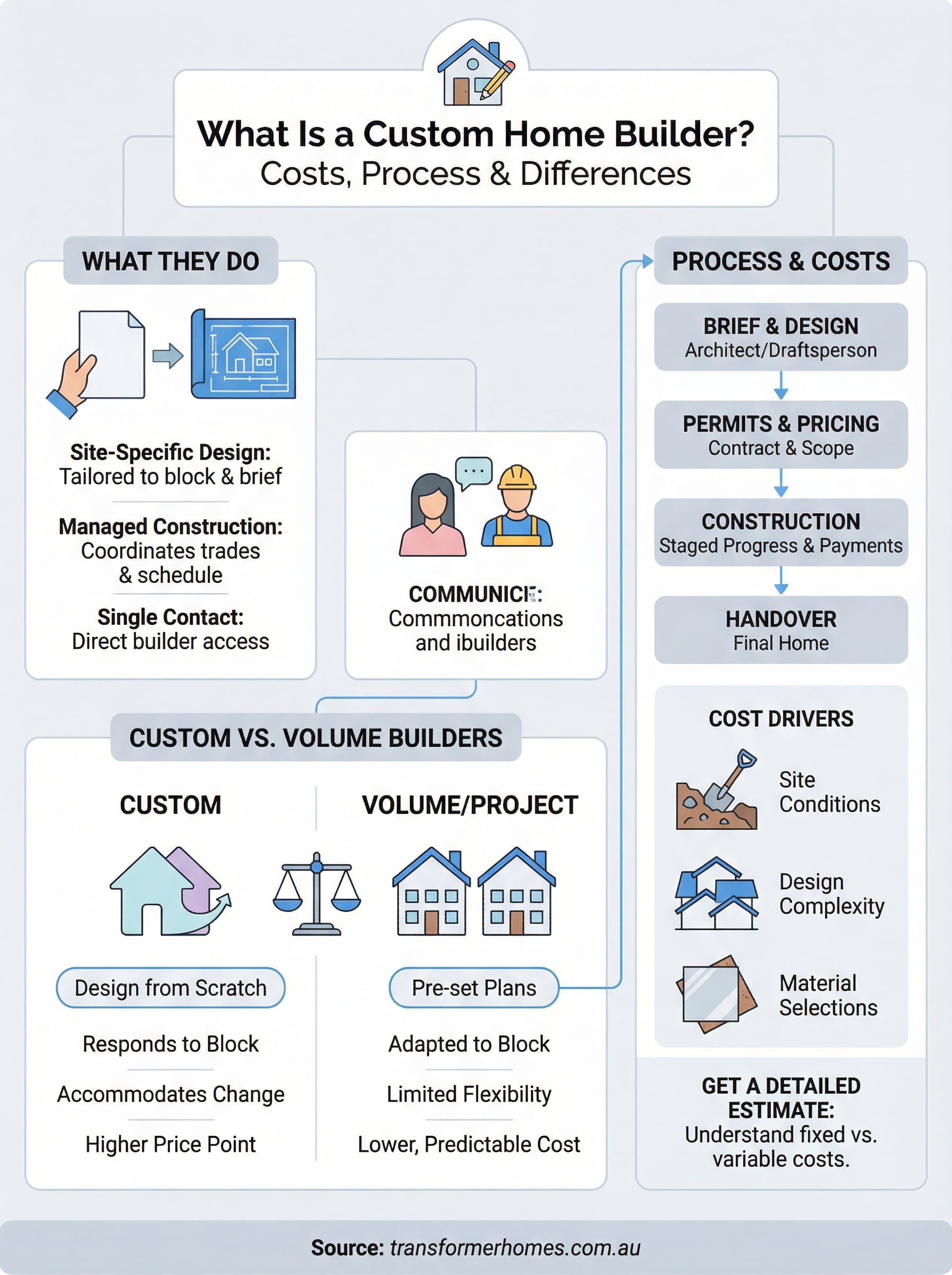
A custom home builder manages the entire process of designing and constructing a residential property specifically for you. When people ask what is a custom home builder, the clearest answer is this: someone who starts with a blank page and your brief, not a pre-drawn plan from a catalogue. Every decision, from the floorplan to the facade, reflects your block, your lifestyle, and your priorities.
Design that starts with your block
The land itself shapes everything. Orientation, slope, neighbouring structures, and council overlays all influence what’s possible before a single line is drawn. A custom builder works alongside architects and designers to develop a design that responds to your specific site, rather than forcing a generic plan onto land it was never drawn for. That site-specific approach is what separates a truly tailored home from a modified volume build.
The design process isn’t about choosing from Column A or Column B. It’s about building something that wouldn’t exist without your input.
Managing every part of the build
Once the design is locked in, your builder coordinates the full construction process. That includes engaging and supervising subcontractors, managing the build schedule, handling council permits and inspections, and keeping you informed at each stage. A good custom builder acts as your single point of contact throughout, so you’re not chasing trades or decoding progress reports on your own.
They also make decisions daily that affect quality and cost, which is why a builder’s experience and communication style matter as much as their portfolio. Selecting materials, resolving on-site issues, and maintaining build standards all sit with the builder. The depth of that responsibility is what makes choosing the right one so important.
Custom vs project and volume builders
Understanding what is a custom home builder becomes clearer when you place it alongside the alternatives. Project and volume builders work on a bulk model: pre-drawn plans, pre-negotiated materials, and a production-line process that keeps costs predictable. That approach suits some buyers, but it trades design flexibility for efficiency in ways you’ll feel throughout the entire build.
How the two models compare
The differences between custom and volume building show up across several areas that matter to your day-to-day experience:
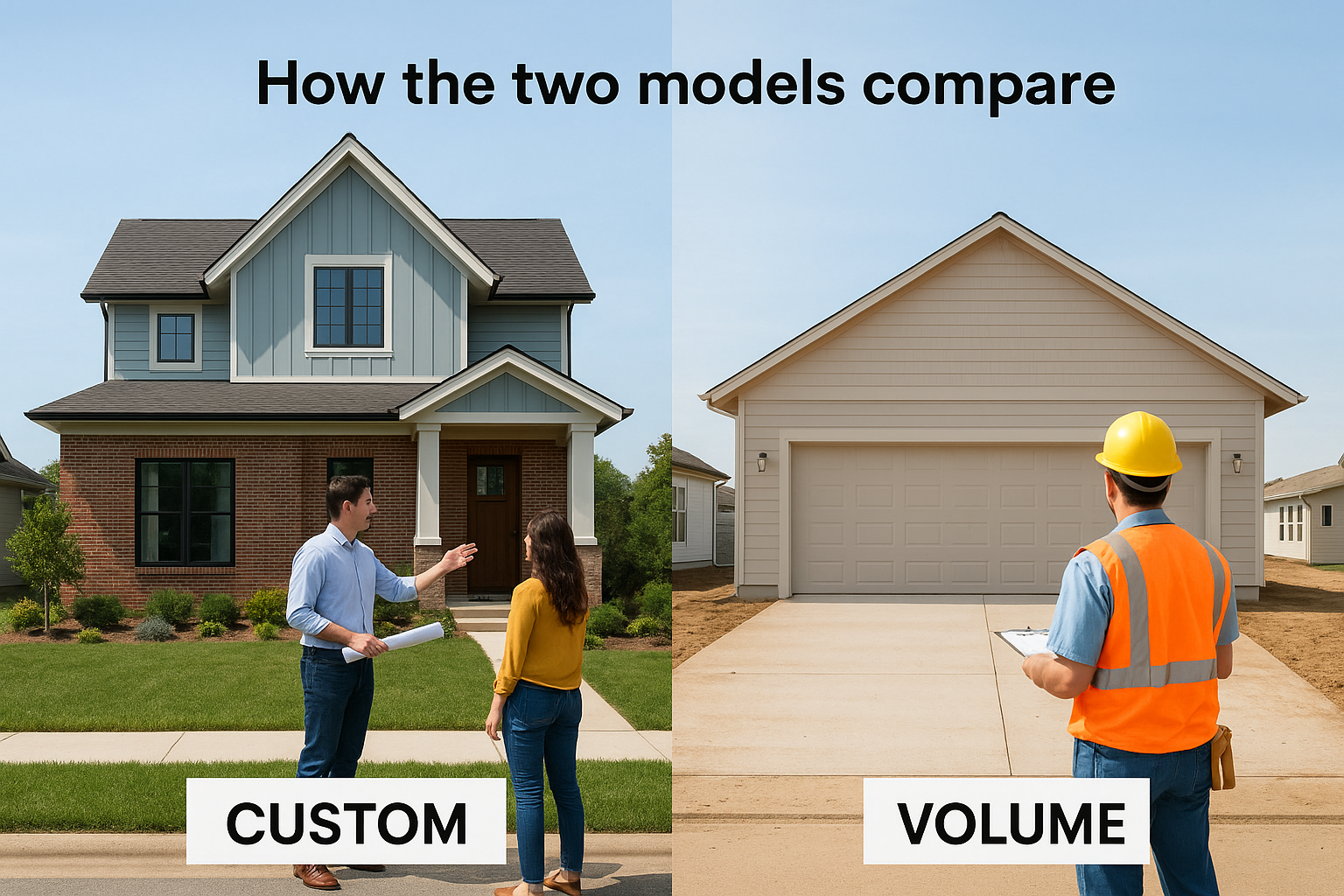
- Design: Custom starts with your brief; volume starts with an existing plan
- Site response: Custom designs respond to your block; volume plans are adapted after the fact
- Variations: Custom accommodates change throughout; volume charges a premium for most modifications
- Communication: Custom gives you direct builder access; volume often routes you through a sales team
With a project builder, the decisions are largely made before you sign, which limits your ability to respond to site conditions or shift your thinking mid-build. A custom builder keeps you involved in those decisions at every stage, which means the finished home reflects your priorities rather than a standardised brief.
Choosing volume over custom isn’t always about budget. Sometimes it comes down to how much control you want over the result.
Costs and what drives the price
Custom homes typically cost more per square metre than volume builds, but understanding why helps you make sense of what you’re actually paying for. When people ask what is a custom home builder, cost is usually the follow-up question. The honest answer is that the price reflects the level of design work and direct involvement specific to your project. Unlike volume builders who spread design costs across hundreds of identical builds, your builder is pricing a one-off from the ground up.
What pushes the price up
Several factors move the final number on a custom build, and many of them sit outside the selections you make in a showroom:
- Site conditions: slope, rock, and poor soil all add to excavation and foundation costs
- Design complexity: open spans, non-standard rooflines, and high ceilings require more engineering
- Material selections: premium finishes, imported fixtures, and custom joinery add up quickly
- Council requirements: heritage overlays and planning permits carry their own costs
The biggest budget surprises in custom builds usually come from the site itself, not the finishes.
Getting a realistic budget
Your builder should walk you through a detailed cost estimate before you commit to anything. Provisional sums and prime cost items need to be clearly identified early, so you know where the fixed costs end and the variables begin.
The custom build process step by step
Most people asking what is a custom home builder don’t realise how involved the process actually is. A custom build typically moves through several distinct stages, each requiring decisions from you before the next one begins.
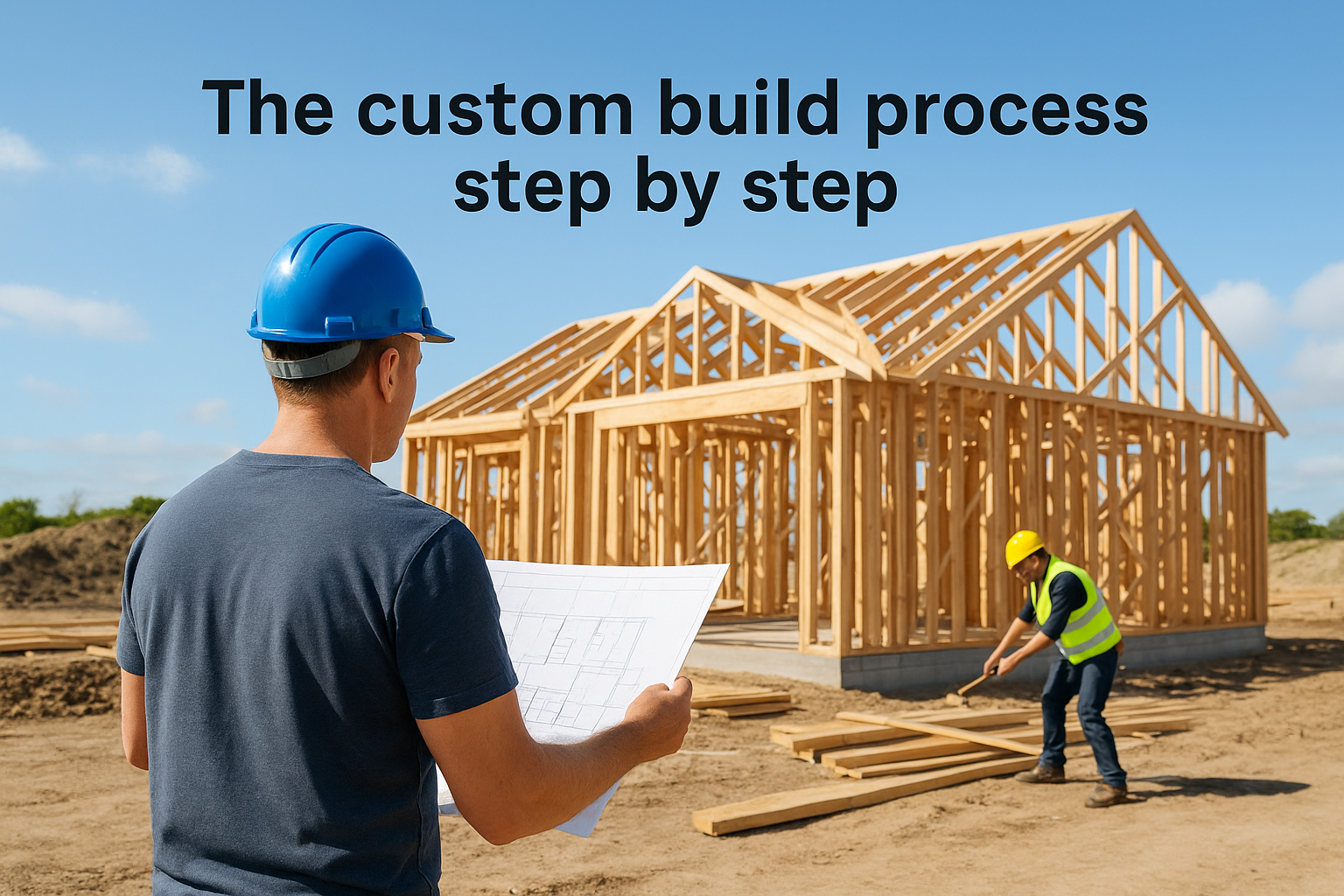
From brief to design
Your builder works with you to establish a clear project brief before any drawings are produced. That brief covers your block dimensions, lifestyle needs, budget ceiling, and council requirements. Once the scope is agreed, an architect or draftsperson develops the design, and you review and refine it until it reflects exactly what you want.
Key inputs your brief should cover:
- Block dimensions and orientation
- Council overlays or heritage requirements
- Budget ceiling and non-negotiable features
Permits, pricing, and construction
With an approved design, your builder submits planning and building permit applications to council and prepares a final contract with a detailed scope of works. Construction then moves through structured stages, typically site preparation, slab, frame, lock-up, fix, and final completion. Each stage triggers an inspection and a progress payment, giving you clear visibility over where your money goes throughout the build.
Understanding the payment schedule before you sign is one of the most practical steps you can take to avoid cash flow surprises during your build.
How to choose the right custom builder in Melbourne
Knowing what is a custom home builder is one thing; finding the right one for your project is another. Melbourne’s building market includes everything from boutique custom firms to larger companies that use the word "custom" loosely. Before you commit to anyone, verify that their experience actually matches your project type, whether that’s a new build on your own land, a dual occupancy, or a substantial renovation.
Questions to ask before you sign
The conversation you have before signing tells you more than a portfolio ever will. Ask how they manage subcontractors, how often you’ll receive progress updates, and who your day-to-day contact will be throughout the build. A builder who gives you clear, direct answers is a stronger indicator than one who hands you a glossy brochure.
The builder’s willingness to answer difficult questions upfront is often the clearest sign of how they’ll communicate once work begins.
- How do you handle variations or unexpected site conditions?
- What does your payment schedule look like stage by stage?
- Can I speak with a previous client about their experience?
Checking their licence through the Victorian Building Authority takes minutes and confirms they are registered to build in your state.
Next steps
Understanding what is a custom home builder gives you a much clearer starting point for planning your project. The gap between a volume build and a genuinely custom home is significant, and it shows up in design flexibility, site responsiveness, and the quality of communication you receive throughout the process. Now that you understand where those differences sit, you can evaluate builders against criteria that actually matter rather than just comparing price lists.
Your next move is to speak with a builder who has direct experience with your project type in your area. If you’re building in Melbourne’s northern or western suburbs, Transformer Homes works with homeowners and landowners on custom builds, dual occupancy projects, and substantial renovations. Bring your block details and your brief, and you’ll get a straight conversation about what’s achievable and what it’s likely to cost. Talk to the team at Transformer Homes to get started.
