
If you’re planning to renovate, extend, or build near a heritage-listed property in Melbourne, you’ll likely need to understand what is a heritage impact statement before submitting your development application. It’s one of those documents that can stall an entire project if you get it wrong, or skip it altogether. Many homeowners in suburbs like Northcote, Preston, and Thornbury encounter this requirement for the first time and aren’t sure where to start.
A heritage impact statement (sometimes called a Statement of Heritage Impact) is a formal document that assesses how your proposed works will affect a place with heritage significance. Local councils across Melbourne require it as part of the planning permit process, and it carries real weight in whether your application gets approved or refused. At Transformer Homes, we regularly work with clients on renovations and new builds in heritage overlay areas, so we’ve seen firsthand how important it is to get this step right early.
This article breaks down the purpose of a heritage impact statement, what it needs to include, and the practical steps involved in preparing one for your council submission. Whether you’re adding a rear extension or planning a full home transformation, this guide will help you understand exactly what’s expected before you lodge your application.
Why heritage impact statements matter in planning
A heritage impact statement does more than satisfy a council checkbox. It demonstrates to the relevant planning authority that you’ve genuinely assessed the heritage significance of a place and considered how your proposed works fit within that context. Understanding what is a heritage impact statement helps you see why it carries real weight in the planning process. Without it, your planning permit application is likely to be returned incomplete, adding weeks or months to your project timeline.
A heritage impact statement is often the document that determines whether a council planner recommends approval or refusal of your application.
How councils use your statement in decision-making
When a council planner reviews your application, the heritage impact statement is one of the primary documents they use to assess impact. They look at whether your proposal respects the character, fabric, and setting of the heritage place. If your statement is vague or fails to address specific heritage values, the planner may request additional information or issue a refusal without further review.
In Victoria, Heritage Overlay provisions under the Planning and Environment Act 1987 give councils authority to assess and control works to heritage places. The statement you submit needs to align with the guidelines set out by Heritage Victoria and your local planning scheme. Getting this alignment right early means fewer back-and-forth requests and a smoother path to permit approval.
Why skipping it costs more in the long run
Some homeowners assume that a small rear addition or minor internal change won’t trigger the heritage statement requirement. In practice, even modest alterations to a heritage-listed property or a property within a heritage overlay can require a full statement. Discovering this after lodging your application means delays, additional professional fees, and in some cases, a refused permit that needs to be appealed. Engaging a heritage consultant at the start of your project protects both your budget and your timeline.
When you need one in Victoria
In Victoria, the Planning and Environment Act 1987 and local planning schemes set out exactly when a heritage impact statement is required. The short answer is: if your property sits within a Heritage Overlay, you’ll almost certainly need one before council will assess your planning permit application. Understanding what is a heritage impact statement helps you identify this requirement early rather than after you’ve already submitted your application.
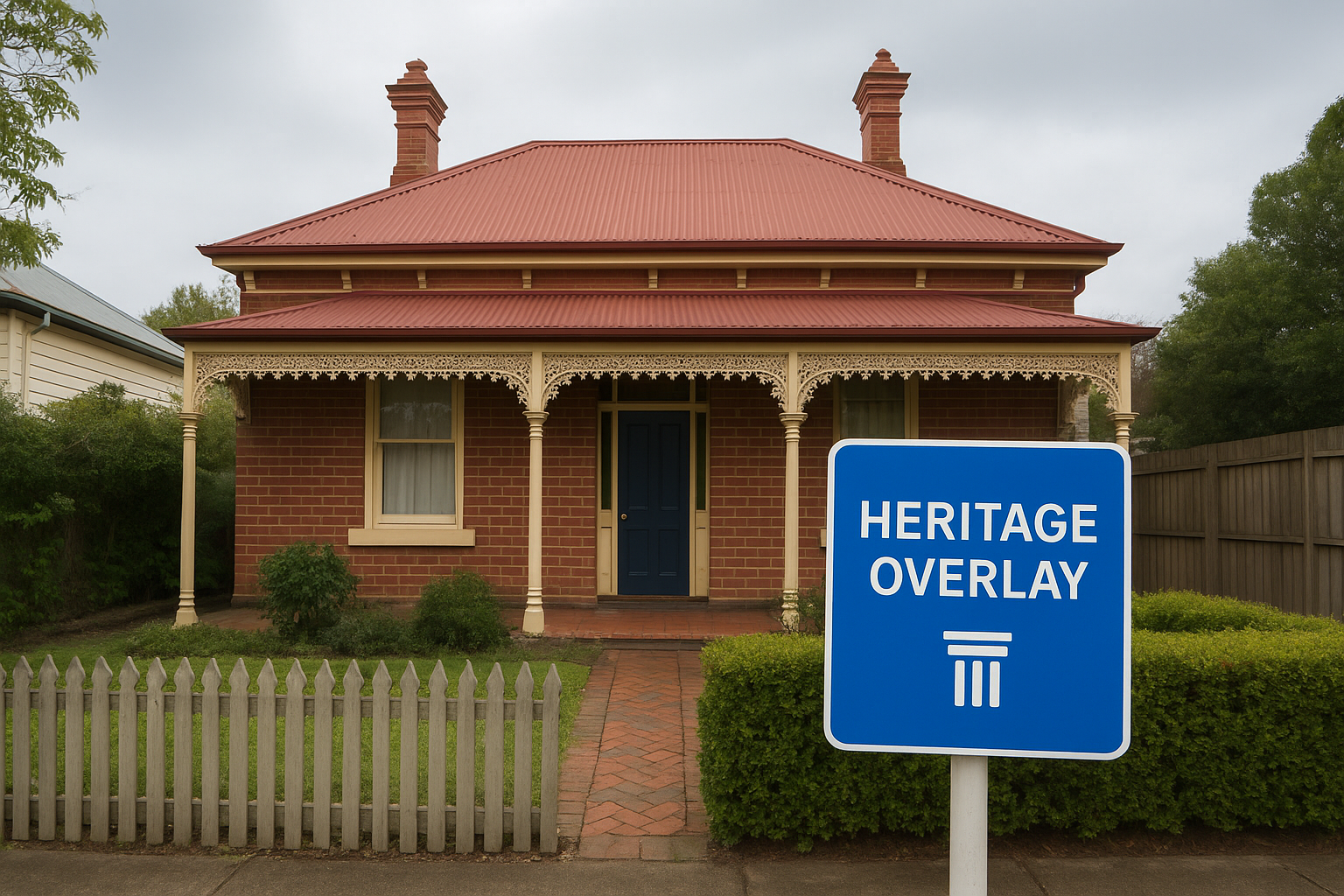
Properties within a Heritage Overlay
Your council’s planning scheme maps show whether your property falls within a Heritage Overlay (HO). This applies to individually heritage-listed properties as well as those located within a precinct-wide overlay, where surrounding buildings contribute to the recognised character of an area. You can check your property’s overlay status through your council’s online planning portal or the Victorian Government’s Planning Maps Online tool.
Works that commonly trigger the requirement
Not every job requires a full statement, but most external alterations and significant internal works to an overlaid property do. Common triggers include:
- Rear or side extensions
- Demolition of any original fabric
- New dwellings on heritage-affected land
- Alterations to rooflines, facades, or original windows
- Construction of outbuildings visible from the street
When in doubt, contact your council’s heritage planner before lodging anything.
What a heritage impact statement must include
Understanding what is a heritage impact statement also means knowing exactly what content it needs to contain. Heritage Victoria and local councils expect a structured document that addresses the heritage values of the place and evaluates the impact of your proposed works against those values. A vague or incomplete statement is one of the most common reasons councils request more information, which adds weeks to your permit timeline.
Your statement needs to do more than describe your proposal; it must actively assess the impact against identified heritage values.
Core components councils expect
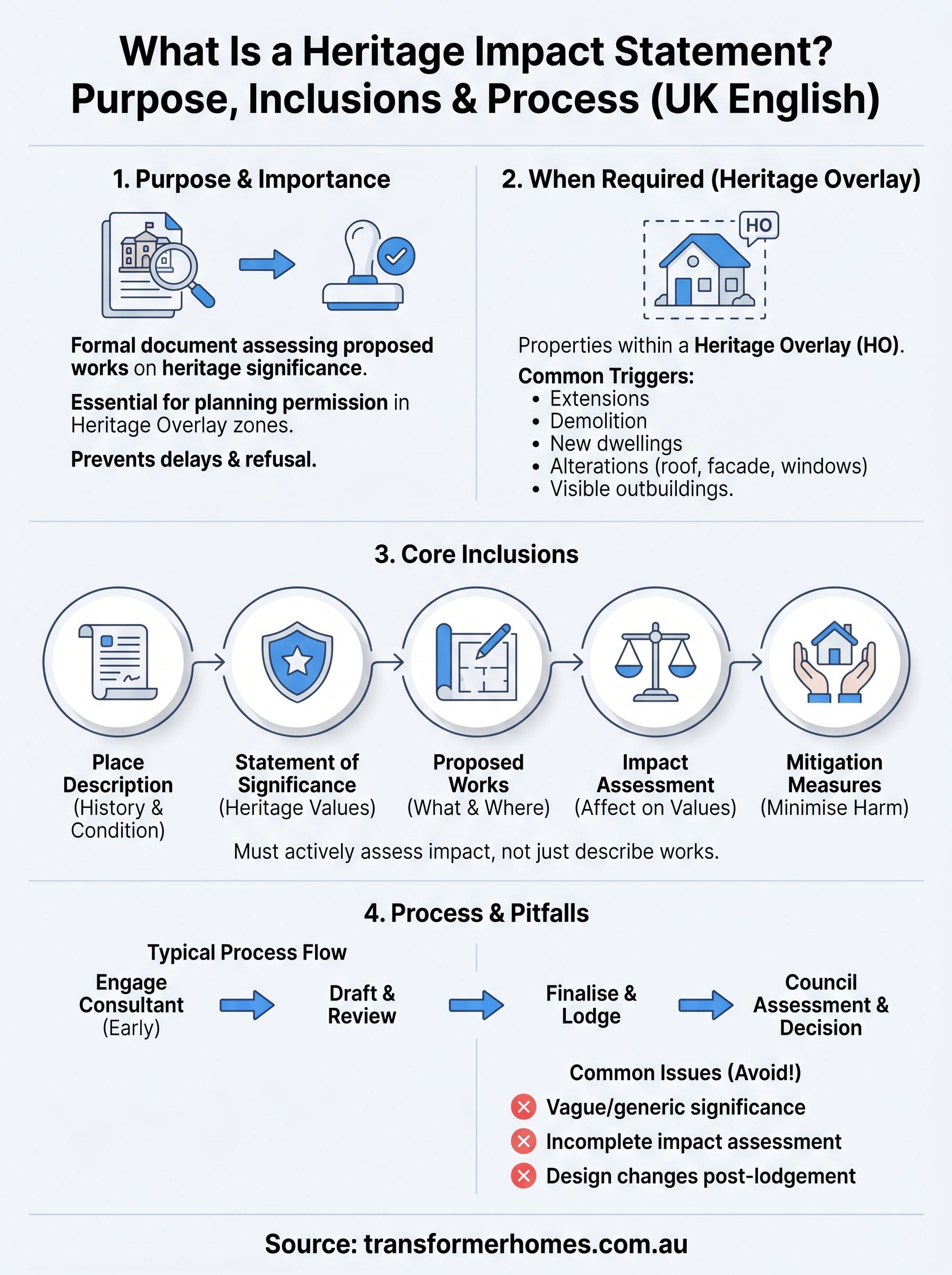
Most councils in Victoria require your statement to cover a consistent set of elements, regardless of the scale of your project. Your heritage consultant will typically structure the document around the following:
- Description of the place: history, original fabric, and current condition
- Statement of significance: what heritage values the place holds and why
- Description of proposed works: what you intend to do and where
- Impact assessment: how the works affect the identified heritage values
- Mitigation measures: steps taken in your design to minimise harm to significant fabric
Each section builds on the last, giving the council planner a clear and complete picture of your project within its heritage context.
How the process works from brief to approval
Once you understand what is a heritage impact statement and confirm you need one, the process follows a clear sequence of steps from initial brief through to council approval. Most projects move through this process in four to six weeks, assuming your consultant has full access to the property and your design documentation is complete before they begin.

Starting the heritage impact statement process early, ideally before you finalise your design, gives you the best chance of addressing heritage concerns before they become costly problems.
Working with a heritage consultant
Your first step is engaging a qualified heritage consultant to assess the place and prepare the statement. They’ll review your proposed design, inspect the property, and research the site’s documented heritage history using council records and local heritage studies.
Once the draft statement is complete, your architect or builder reviews it alongside the rest of your permit documents. Your consultant then finalises the statement and it gets lodged with your planning application. From there, the council planner assesses everything together, and if the statement is thorough and well-reasoned, it significantly reduces the likelihood of further information requests or objections during the review period.
Common issues councils flag and how to avoid them
Council planners see the same problems come up repeatedly, and most are entirely preventable with the right preparation. Knowing these issues before you submit puts you in a much stronger position to secure a smoother, faster approval.
Vague or generic significance statements
One of the most common problems is a significance statement that feels generic or copy-pasted rather than specific to your property. If the statement doesn’t reflect the actual heritage values present on your site, a planner will likely request more information before proceeding.
A site-specific statement backed by documented evidence carries far more weight than a generalised description.
Your consultant should draw on council heritage studies and physical inspection to produce a statement that is genuinely specific to your site rather than a broad description of architectural styles that could apply to any property in the street.
Incomplete impact assessments
Understanding what is a heritage impact statement also means recognising that describing your proposed works is not the same as assessing their impact. Your consultant needs to address each identified heritage value directly, explaining what harm the works create and how your design choices reduce that harm.
Submitting your statement before your design documentation is finalised is another avoidable mistake. If your plans change after lodgement, the council may require a revised statement, adding delays that careful upfront planning could have avoided entirely.
Next steps
Now that you understand what is a heritage impact statement and what the process involves, you’re in a much better position to approach your project without expensive surprises. The key takeaway is simple: engage a heritage consultant early, confirm your property’s overlay status before you finalise your design, and make sure your statement is site-specific rather than generic.
If your property sits in a Heritage Overlay in Melbourne’s northern or western suburbs, the planning process has real complexity, but it’s entirely manageable with the right team behind you. Skipping steps or lodging an incomplete statement creates delays that proper preparation avoids entirely.
At Transformer Homes, we work with homeowners on renovations, extensions, and new builds in heritage-sensitive areas across Melbourne. If you’re ready to move forward with your project, speak with the Transformer Homes team to discuss how we can help you navigate the planning process from start to finish.
