
A kitchen renovation can feel overwhelming before you even pick up a tile sample. Between juggling budgets, choosing materials, coordinating trades, and keeping your household running, it’s easy to lose track of critical steps. That’s exactly why having a kitchen renovation planning checklist matters, it turns a complex project into a sequence of manageable, predictable decisions that keep you on track from day one.
At Transformer Homes, we’ve guided homeowners across Melbourne’s Northern and Western suburbs through hundreds of kitchen remodels. One pattern we see repeatedly: the projects that run smoothly aren’t necessarily the ones with the biggest budgets, they’re the ones with the clearest plans. A solid checklist prevents costly backtracking, reduces stress, and gives you real control over your timeline and spend.
This guide walks you through every stage of planning a kitchen renovation, from setting a realistic budget and locking in your design layout to selecting materials and understanding the order each task needs to happen. We’ve also included practical tips drawn from our own build process so you can approach your renovation with confidence. Whether you’re updating a tired galley kitchen in Preston or gutting a full space in Thornbury, this checklist will help you stay organised and avoid surprises.
What to decide before you plan anything
Before you touch your kitchen renovation planning checklist, you need to answer a handful of foundational questions. Skipping this step is the single biggest reason renovations stall or blow out midway through. Getting clarity upfront on a few key areas means every decision that follows has a solid basis, rather than being made on the run when the pressure is on.
Know your non-negotiables
Start by separating what you must have from what you’d simply like to have. These are your non-negotiables: the features, functions, or design outcomes you won’t compromise on. Writing these down before anything else stops them from getting lost once the excitement of picking finishes takes over.
Your non-negotiables shape every downstream decision, from layout to budget allocation, so define them before you open a single product catalogue.
Common non-negotiables include:
- Bench run length: the minimum continuous work surface your household needs
- Storage configuration: whether you prioritise drawers over cupboards or need a pantry
- Appliance placement: fixed by existing plumbing, gas, or electrical rough-in positions
- Natural light: whether you need to protect or add window openings
Clarify who is doing what
Decide early whether you’re hiring a builder to manage the full project, using a kitchen company for supply and install only, or project-managing the trades yourself. Each path carries a different level of involvement, cost structure, and risk. A builder like Transformer Homes handles coordination across cabinetmakers, electricians, plumbers, and tilers, which removes the pressure of scheduling from your plate entirely.
If you plan to manage trades independently, you need to commit the time to do it properly, because delays caused by poor sequencing cost money and extend your timeline significantly. Consider these questions before you move on:
- Who has final sign-off on design and material decisions?
- What is your household’s tolerance for disruption during the build?
- Do you have a trusted builder, or do you still need to get quotes?
Step 1. Define scope and set a realistic budget
Scope and budget are inseparable decisions that shape every part of your kitchen renovation planning checklist. Define both clearly before you speak to a single tradesperson, and you’ll have a far stronger basis for getting accurate quotes and avoiding costly changes mid-build.
Define your renovation scope
Before you price anything, you need to specify exactly what the renovation covers. A full gut involves removing walls, relocating plumbing, and rewiring circuits, while a cosmetic refresh might only touch cabinet doors and benchtops. Writing your scope down in plain terms prevents misunderstandings with your builder and gives tradespeople a clear basis for quoting. Use this simple scope template to get started:
| Scope area | Included? | Notes |
|---|---|---|
| Cabinet replacement | Yes / No | Full, partial, or doors only |
| Benchtop replacement | Yes / No | Material preference |
| Plumbing relocation | Yes / No | Sink, dishwasher |
| Electrical upgrade | Yes / No | Circuits, rangehood |
| Flooring | Yes / No | Area in m² |
| Splashback | Yes / No | Tile, glass, or stone |
Set a realistic budget
Once your scope is confirmed, allocate a budget with a built-in contingency. A figure that covers only best-case scenarios will fail the moment an unexpected issue surfaces, and that happens on the majority of renovations. Add 15 to 20 per cent on top of your base cost estimate as a financial buffer.
Never treat your contingency as spending money; it exists specifically to absorb genuine surprises.
Keeping contingency separate from your main allocation also makes it easier to monitor whether your project is tracking on cost as the work progresses.
Step 2. Lock in your layout and key design choices
Your kitchen layout determines how functional the finished space will be, so locking it in before you finalise anything else in your kitchen renovation planning checklist is essential. Changes to layout after cabinetry is ordered or plumbing is roughed in carry real costs, so treat this step as a firm decision point.
Choose a layout that matches how you cook
The most common layouts each suit different room shapes and household sizes. Picking the right layout for your space prevents a design that looks good on paper but frustrates you in daily use.

| Layout | Best suited for | Key trade-off |
|---|---|---|
| Galley | Narrow rooms, single cook | Limited turning space |
| L-shape | Corner spaces, open-plan | Wasted corner storage |
| U-shape | Larger kitchens, multiple cooks | Needs adequate floor area |
| Island | Open-plan, social cooking | Requires 900mm clearance |
Nail your key design decisions
Once your layout is confirmed, write down every major design decision before briefing a cabinetmaker or any trades. A single written brief reduces confusion and keeps your project moving without costly revisions.
Include these key decisions in your brief:
- Ceiling height and cornice detail
- Rangehood type and flue position
- Overhead cabinet depth and height
- Island or peninsula dimensions and overhang
Locking in your design brief before trades are booked prevents changes that a clearer upfront decision would have avoided.
Step 3. Choose materials, finishes, and appliances
Material and appliance selection is where your kitchen renovation planning checklist gets tactile. The choices you make here affect both your daily experience in the space and your total project cost, so approach them systematically rather than reactively.
Pick materials that match your budget and use
Your benchtop, cabinetry finish, and splashback together make up a significant portion of your material spend. Match each material to its actual conditions: a household with young children needs a more durable, forgiving surface than an investment property. Use this reference to guide your selection:
| Material | Durability | Cost range (AUD) | Best suited for |
|---|---|---|---|
| Laminate benchtop | Moderate | $150-$400/lm | Budget-conscious builds |
| Engineered stone benchtop | High | $600-$1,200/lm | Family kitchens |
| Porcelain tile splashback | High | $80-$200/m² | High-heat zones |
| Polyurethane cabinetry | High | Mid-to-high | Long-term daily use |
Select appliances early
Appliance dimensions directly control cabinet sizing, so confirm your selections before your cabinetmaker finalises drawings. A 900mm oven requires different cavity dimensions than a 600mm model, and ordering cabinets before locking in appliances is one of the most common and costly sequencing mistakes on residential kitchen projects.
Confirm appliance specifications with your cabinetmaker before cabinet orders are placed, not after.
Step 4. Line up approvals, trades, and site logistics
This step is where your kitchen renovation planning checklist moves from paper into the real world. Before any work starts on site, you need to confirm permits, book trades in sequence, and organise site access, because a gap in any of these areas will stall your project and add unnecessary cost.
Check what approvals you need
Most kitchen renovations in Victoria don’t require a building permit unless you’re moving walls, relocating plumbing stacks, or altering structural elements. However, any structural change requires a permit from your local council before work begins. Contact your local council or a registered building surveyor to confirm exactly what applies to your project scope.
Sorting approvals before you book trades prevents costly hold-ups once work is underway.
Book trades in the correct order
Trades must arrive in a specific sequence to avoid rework and wasted callout fees. Use this order as your baseline schedule:
- Demolition
- Structural and carpentry work
- Rough-in plumbing and electrical
- Cabinetry installation
- Benchtop templating and installation
- Tiling and splashback
- Appliance connection and fit-off
- Final electrical and plumbing sign-off
Confirm confirmed availability and lead times for each trade at least four weeks before your start date, since skilled tradespeople in Melbourne book out quickly, particularly in the Northern and Western suburbs.
Step 5. Build a timeline and manage the work in order
Your timeline is the final element that pulls your kitchen renovation planning checklist together. Without a written schedule that maps each task to a specific week, individual delays compound into major overruns before you realise it.
Map your weeks from demolition to handover
A realistic residential kitchen renovation in Melbourne runs eight to fourteen weeks from demolition to completion, depending on scope and trade availability. Use this template as your starting framework:
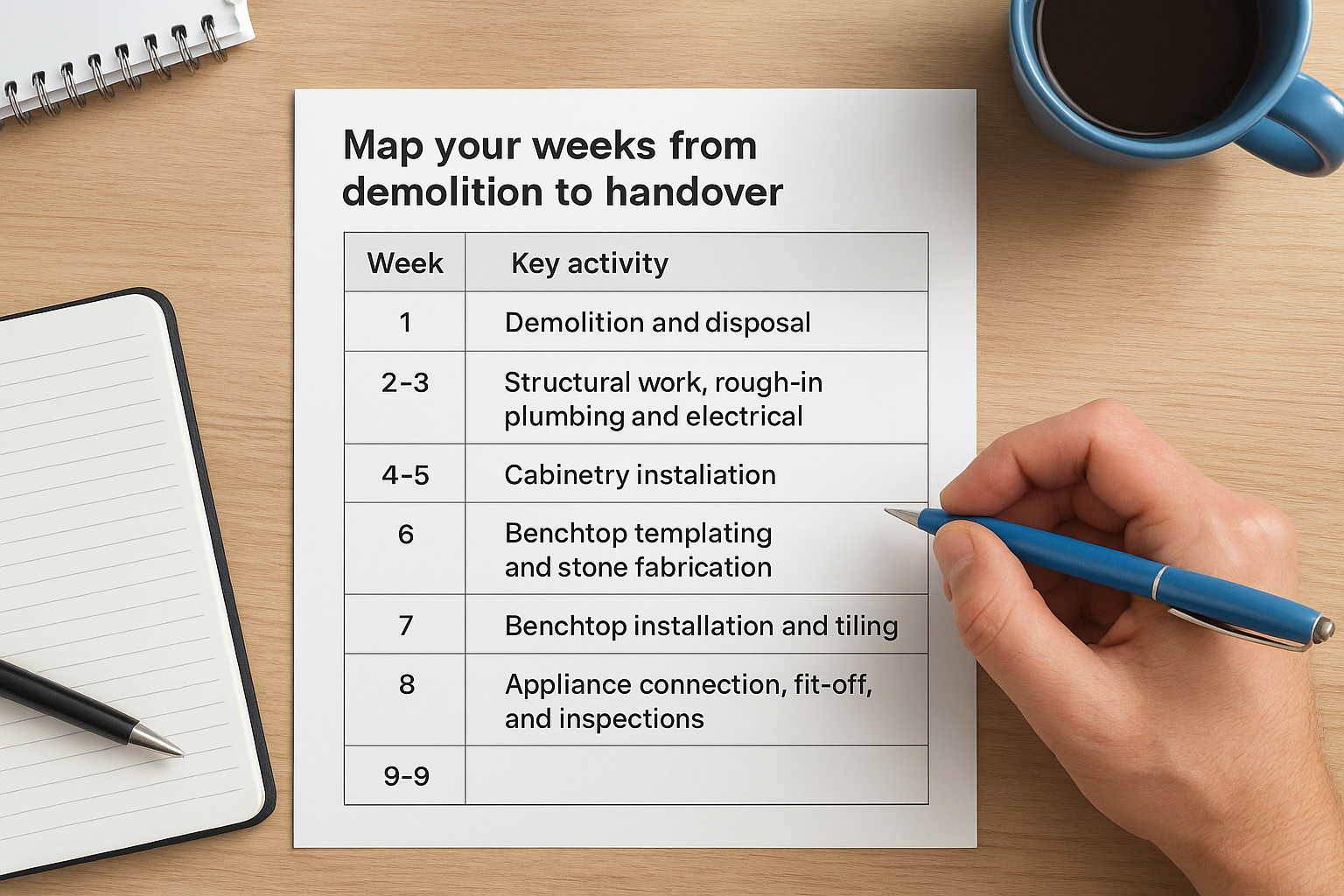
| Week | Key activity |
|---|---|
| 1 | Demolition and disposal |
| 2-3 | Structural work, rough-in plumbing and electrical |
| 4-5 | Cabinetry installation |
| 6 | Benchtop templating and stone fabrication |
| 7 | Benchtop installation and tiling |
| 8-9 | Appliance connection, fit-off, and inspections |
Build at least one week of buffer into your schedule to absorb trade delays without pushing your overall completion date.
Track progress against your plan
Once the build starts, review your schedule weekly against actual progress. Flag any task that falls more than three days behind immediately, because trade sequences are tight and a delay in one area flows directly into the next. Keep a simple written log noting what was completed each week and what shifted, so you always know exactly where your project stands.
Next steps
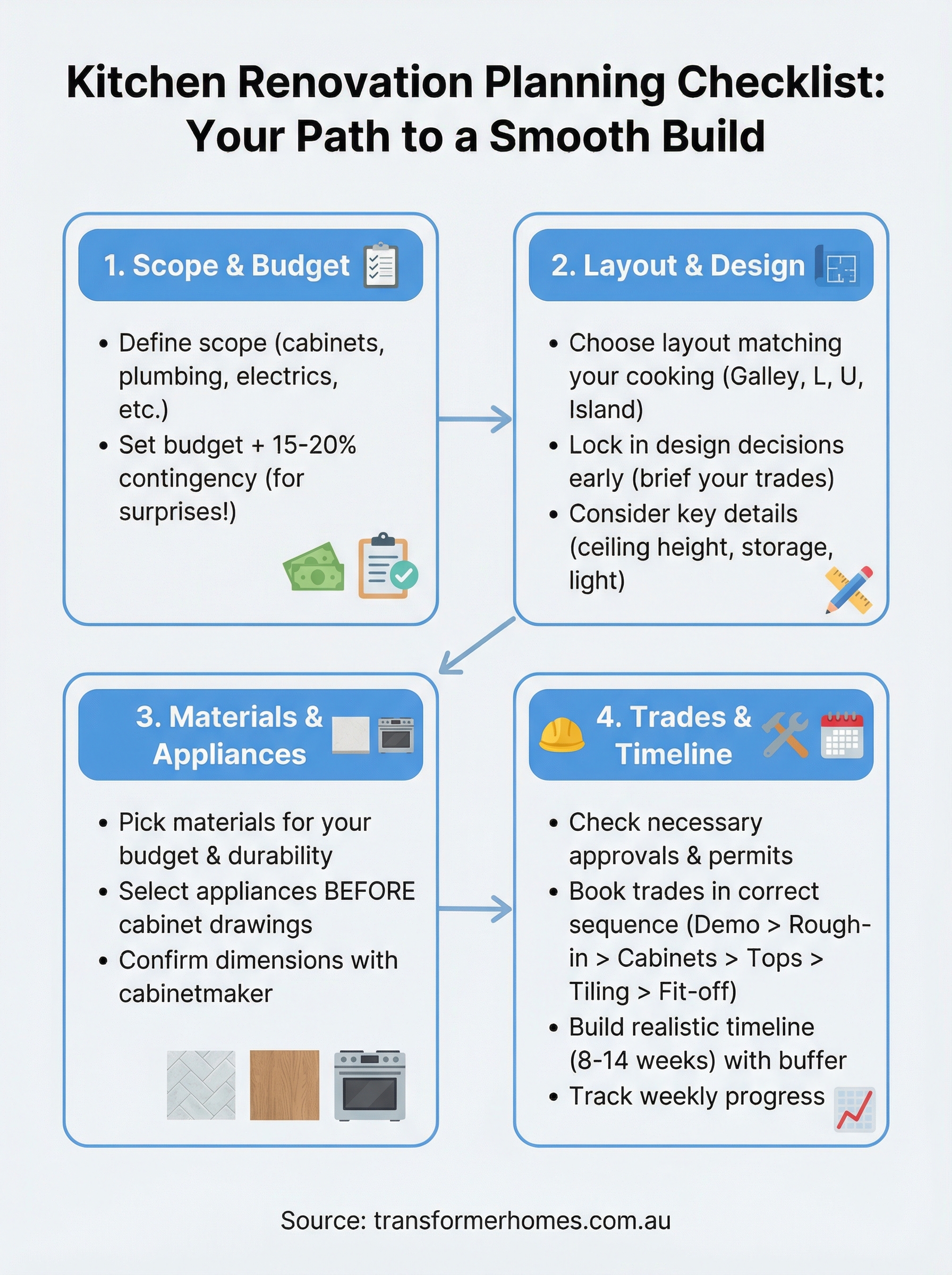
Your kitchen renovation planning checklist now covers every stage, from defining non-negotiables through to tracking progress against your build schedule. The most important action you can take right now is to start at the top of this list and work through each step in order before you contact a single tradesperson or set foot in a showroom. Skipping stages to save time upfront consistently creates the delays and cost blowouts that homeowners remember long after the renovation is finished.
If you’re ready to move forward and want a builder who manages the entire process, Transformer Homes works with homeowners across Melbourne’s Northern and Western suburbs to deliver kitchen renovations that stay on time and on budget. From scoping your project through to final fit-off, our team handles the coordination so you don’t have to. Talk to us about your kitchen renovation and get your project started on a solid plan.
