
If you own a block of land in Melbourne and want to make more of it, you’ve probably weighed up dual occupancy vs granny flat at some point. Both options let you add a second dwelling to your property, but they sit in very different categories under Victorian planning rules, and that distinction affects everything from what you can build to what it’s worth down the track.
A granny flat (or dependant person’s unit) comes with specific restrictions on size, occupancy, and resale. A dual occupancy, on the other hand, creates two fully independent homes that can each be separately titled and sold. The right choice depends on your goals, your site, and how much flexibility you need. Getting this wrong can mean wasted time, money, and planning applications that lead nowhere.
At Transformer Homes, we design and build dual occupancy developments across Melbourne’s northern and western suburbs. We’ve helped property owners in areas like Northcote, Preston, and Thomastown navigate exactly this decision. This guide breaks down the legal definitions, cost differences, planning requirements, and investment potential of each option so you can figure out which one actually makes sense for your property, before you commit to a path that doesn’t align with your end goal.
What dual occupancy and granny flat mean in Victoria
Understanding these two options starts with the legal definitions used in Victoria, because what each term means here is not what you might assume from common usage. Many people treat them as interchangeable when they are actually two fundamentally different categories under planning law, with different rules, restrictions, and outcomes attached to each.
What a granny flat is under Victorian law
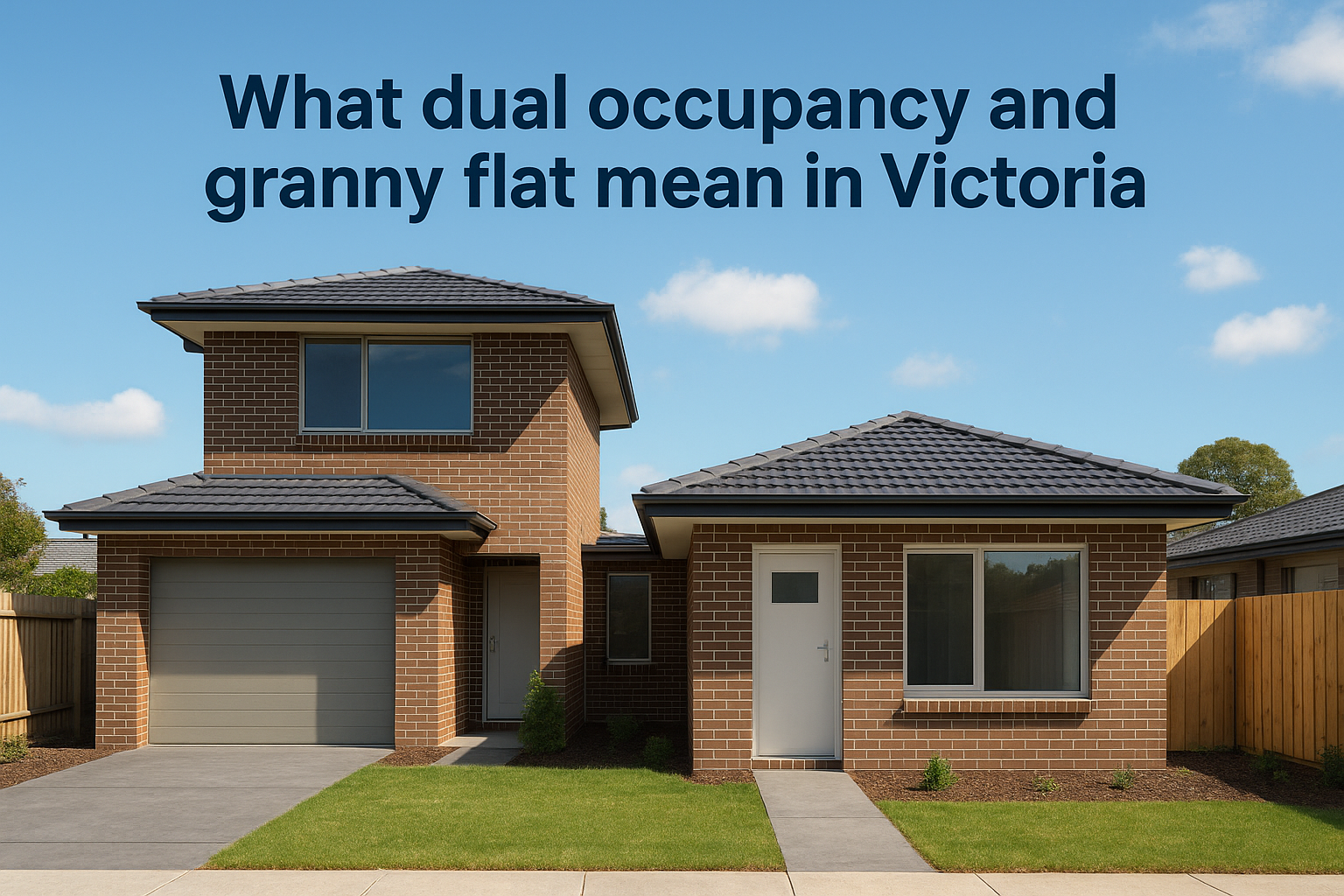
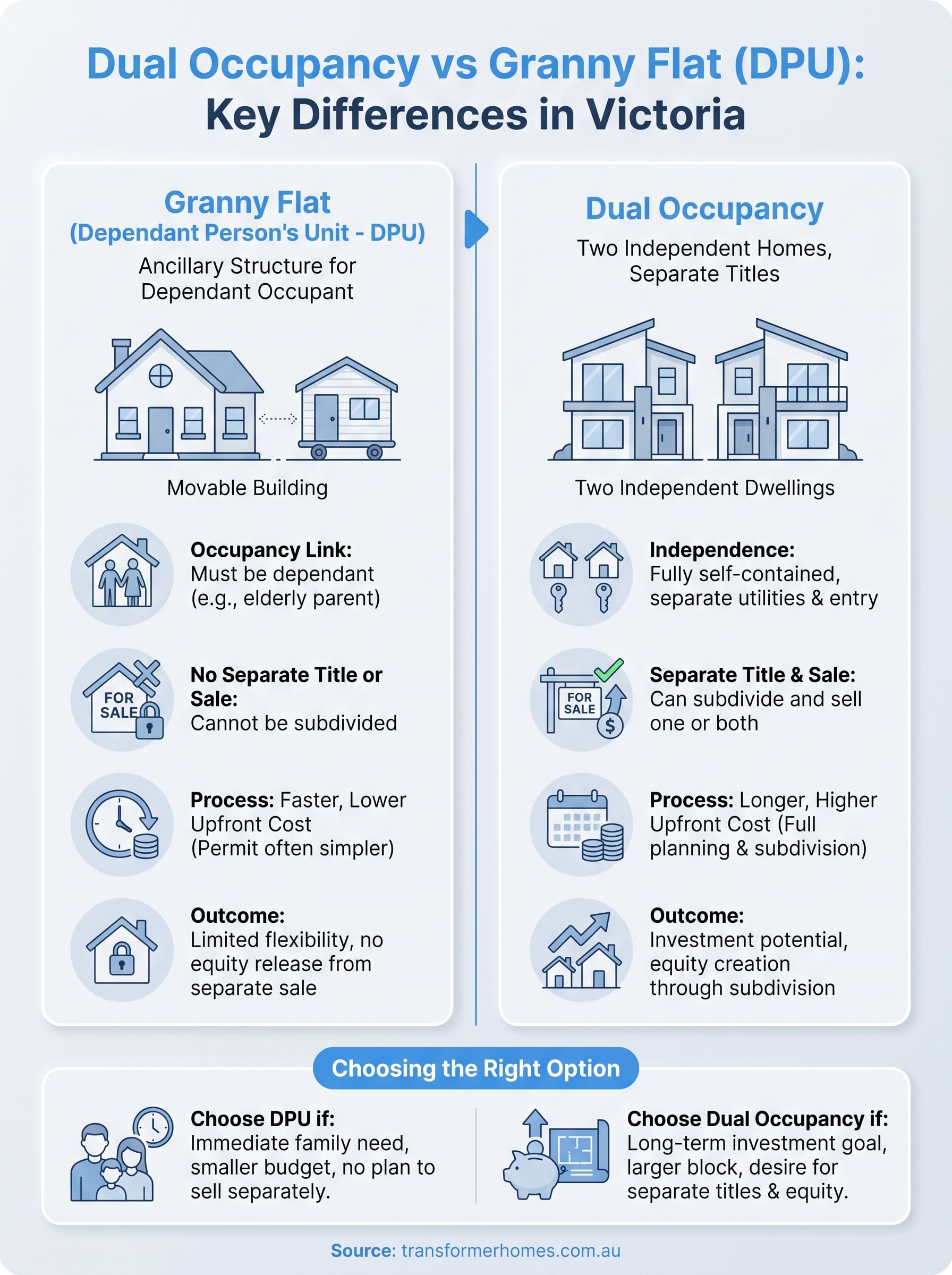
In Victoria, a granny flat is formally known as a dependant person’s unit (DPU). The planning scheme defines it as a movable building on the same lot as an existing dwelling, intended for occupation by a person who is dependent on the main dwelling’s occupants, such as an elderly parent or adult child needing close support. The key word in that definition is "movable": the structure must be capable of being removed from the site.
This classification carries significant limitations that catch many property owners off guard. The unit cannot be separately sold or titled, and it must remain genuinely connected to the main home in terms of occupancy. If the dependant occupant leaves and no replacement who fits the definition moves in, the dwelling may no longer comply with your permit conditions. Understanding this restriction before you start planning saves a lot of wasted time and money.
A dependant person’s unit in Victoria cannot be subdivided or sold separately from the main dwelling, making it unsuitable if your goal is long-term investment or equity release.
What a dual occupancy is under Victorian law
A dual occupancy means two separate dwellings on a single lot, either positioned side by side or stacked on top of each other. Unlike a DPU, each dwelling functions as a fully independent home with its own entry, utilities, and living spaces. There is no requirement that the occupants share any family relationship or even know each other.
The defining advantage of dual occupancy is the ability to subdivide the land under the Subdivision Act 1988 (Vic), which lets you create two separate titles. Once you have two titles, you can sell one dwelling independently, rent both, or live in one and use the rental income from the other to offset your mortgage. That flexibility is what makes dual occupancy the stronger choice for most property investors and owner-occupiers with a long-term financial goal.
How these definitions shape your decision
When you compare dual occupancy vs granny flat, the legal definitions alone tell you a great deal about which path fits your situation. A DPU is designed for a specific family circumstance, and the planning system treats it accordingly. A dual occupancy is treated as a residential development, which means more process upfront but considerably more freedom once the project is complete.
Your block size, zone, and local council overlay also affect which option is even available to you. Not every property in Melbourne’s northern and western suburbs qualifies for dual occupancy development, and not every situation calls for a DPU either. The definitions are your starting point, but your specific site conditions and long-term goals are what ultimately determine which path makes sense to pursue.
Why the difference matters for cost and approvals
The distinction between a DPU and a dual occupancy is not just a technical label. It determines which planning pathway your project follows, how much you spend to get approval, and what the finished development is actually worth. Choosing the wrong option for your situation can add months to your timeline and tens of thousands of dollars to your costs before a single slab is poured.
How the planning process differs
A dependant person’s unit typically requires a straightforward permit from your local council. Because the planning scheme treats a DPU as an ancillary structure rather than a full residential development, the assessment process is generally faster and less document-heavy than what a dual occupancy requires. That said, the DPU pathway closes the door on subdivision entirely, so speed at the approval stage comes at the cost of long-term flexibility.
A dual occupancy application triggers a full planning permit process, which often includes neighbour notification, council assessment against your zone’s ResCode requirements, and sometimes referral to other authorities.
Dual occupancy planning permits in Victoria require your design to satisfy ResCode standards, covering setbacks, overlooking, overshadowing, and private open space. If your block sits within an overlay such as a Neighbourhood Character Overlay or a Significant Landscape Overlay, additional requirements apply and assessment times increase. This is where working with an experienced builder who understands the local planning environment saves you real money.
What this means for your budget
When you compare dual occupancy vs granny flat costs, the dual occupancy route involves higher upfront spending across permits, design, and construction. However, the ability to subdivide and sell one title means that cost can be recovered, leaving you with a retained asset built for effectively less than market value. A DPU carries lower initial cost but produces no new title and therefore no capital event on sale.
Your budget planning should account for permit fees, engineering reports, surveying for subdivision, and connection of separate services to each dwelling. These costs vary by council and site, but treating them as fixed and unavoidable keeps your feasibility numbers realistic from the start.
How approvals work in Victoria step by step
Both approval pathways involve your local council, but the steps, documentation, and timeframes differ considerably depending on which development type you pursue. Knowing what each process involves upfront stops you from being caught off guard mid-project when delays or additional requirements surface.
The DPU approval pathway
Applying for a dependant person’s unit typically means lodging a planning permit application with your local council. Your application needs to include a site plan, floor plans, elevations, and a written explanation of the occupancy arrangement and the relationship between the proposed resident and the main dwelling’s occupants. Most councils assess DPU applications without public notice, which keeps the process shorter than a full residential development.
Once your permit is granted, you need a building permit before construction starts. Your builder coordinates this through a registered building surveyor, who checks the structure against the National Construction Code. Because a DPU must remain movable, your foundation and connection design must reflect that requirement throughout the build.
The dual occupancy approval pathway
When you weigh up dual occupancy vs granny flat, the dual occupancy side involves more steps but delivers a much more valuable outcome. You start with a planning permit application that includes detailed architectural drawings, a shadow diagram, a waste management plan, and often a neighbourhood character statement if your council requires one.
Councils assess dual occupancy applications against ResCode, and some overlays trigger additional referrals that can extend assessment by several months, so building in buffer time from the start protects your feasibility.
After planning approval, you apply for a building permit and, once construction is complete, lodging a plan of subdivision with Land Use Victoria allows you to create two separate titles. Your surveyor prepares the plan, your council endorses it, and Land Use Victoria registers the titles. This final step turns your development into a genuine financial asset rather than simply an improvement to your existing property.
How costs, timelines and designs compare
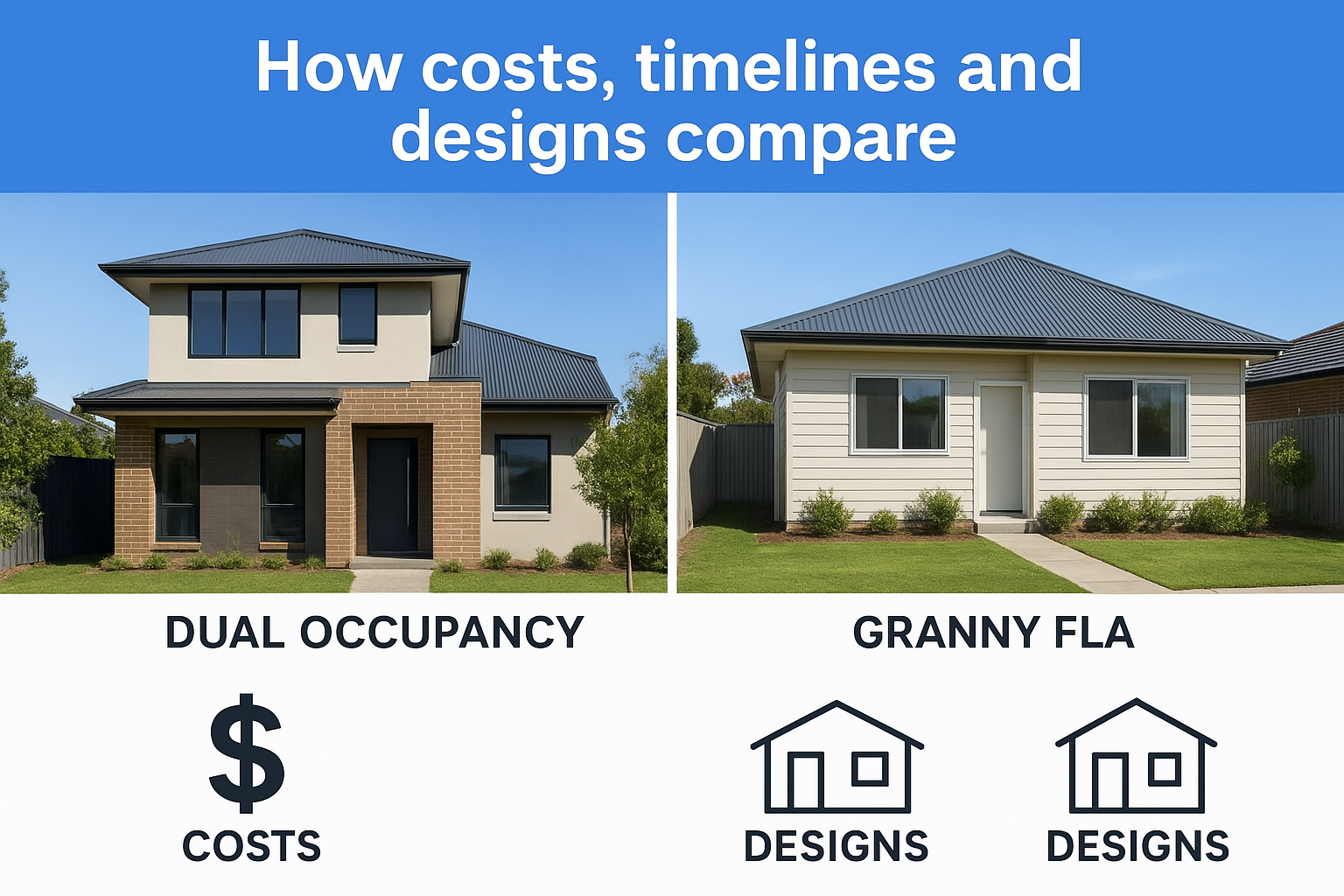
When you weigh up dual occupancy vs granny flat, the financial and practical differences become just as important as the legal ones. Both projects involve significant investment, but the cost structures, construction timelines, and design freedoms are shaped by entirely different sets of rules and outcomes.
What each option typically costs
A dependant person’s unit in Melbourne generally costs between $100,000 and $180,000 to supply and install, depending on size and specification. Your total outlay is lower upfront, but you also receive no new title and no ability to sell the structure independently, which limits your return.
Dual occupancy development costs considerably more, typically ranging from $450,000 to $700,000 or above for two complete dwellings in Melbourne’s northern and western suburbs. That figure includes design, permits, construction, and subdivision costs. However, the finished product creates two separately titled assets, which means your investment produces real, measurable equity.
When comparing costs across both options, factor in subdivision fees, utility connection charges, and surveying costs for dual occupancy, as these can add $30,000 to $50,000 on top of construction.
How long each project takes
A DPU project typically moves faster from approval to completion. Most permits are processed within 30 to 60 days, and construction of a modular or transportable unit can wrap up in eight to fourteen weeks once your building permit is in place. This suits situations where speed is the priority.
Dual occupancy projects carry a longer timeline by design. Planning permits in Victoria can take four to nine months depending on your council and any overlays on your land. Construction then adds another ten to fourteen months for two complete dwellings, so you should budget at least 18 months from initial design to title registration in most cases.
Design constraints you need to know
Your design freedom differs significantly between the two paths. A DPU must remain movable, which limits your structural options and typically means a smaller footprint with fewer custom features. Most DPUs follow a prefabricated format rather than a fully bespoke architectural design.
Full design control across both dwellings is what dual occupancy delivers, including facade treatment, internal layouts, material selection, and outdoor spaces. Your design must still satisfy ResCode setback and overlooking requirements, but within those parameters you can build homes that reflect what the local market actually wants.
How to choose the right option for your block
The right choice between dual occupancy vs granny flat comes down to three things: your end goal, your block’s size and zoning, and your budget for both upfront costs and long-term returns. Answering these honestly before you speak to a designer or builder saves you from committing to a path that works against you.
When a DPU suits your situation
A dependant person’s unit is the right choice when your primary need is housing a family member on your property in the near term, and you have no intention of selling or subdividing. If your block sits in a zone that restricts multi-dwelling development, or your land area is too small to satisfy ResCode setback requirements for two full dwellings, a DPU gives you a practical, lower-cost solution that still adds usable living space.
Consider a DPU if your timeline is short. Planning and construction move faster for a DPU than for a full dual occupancy project, which makes it a better fit if your family’s situation requires a solution within the next six to twelve months.
When dual occupancy is the stronger choice
If your goal involves building equity or generating rental income, dual occupancy is the option that actually delivers on that. Two separate titles give you the ability to sell one dwelling and retain the other, or hold both as long-term rental assets that appreciate independently. A DPU simply cannot produce that outcome.
If you plan to use the second dwelling as a source of income or future sale proceeds, dual occupancy is the only path that gives you both.
Your block size and zoning need to support a dual occupancy application before you proceed. In Melbourne’s northern and western suburbs, most residentially zoned lots above 500 to 600 square metres can support some form of dual occupancy, but an overlay or council-specific requirement may change that. Getting a site assessment early from an experienced builder tells you what your land can actually carry before you spend money on design.
Next steps for your property
Deciding between dual occupancy vs granny flat is not a choice you need to make in the dark. The information in this guide gives you a solid foundation, but your specific block, zone, and financial goals determine which path actually works for you. The clearest next step is getting a site assessment from a builder who knows Melbourne’s northern and western suburbs and understands what your land can carry under current planning rules.
Your time is better spent getting real answers about your property than researching options that may not even be available to you. Bring your land dimensions, your council zone, and your end goal to a conversation with someone who builds these projects regularly. That conversation will tell you whether your block suits a dual occupancy, a DPU, or something else entirely. Talk to the Transformer Homes team to find out what your property can actually support before you commit to anything.
